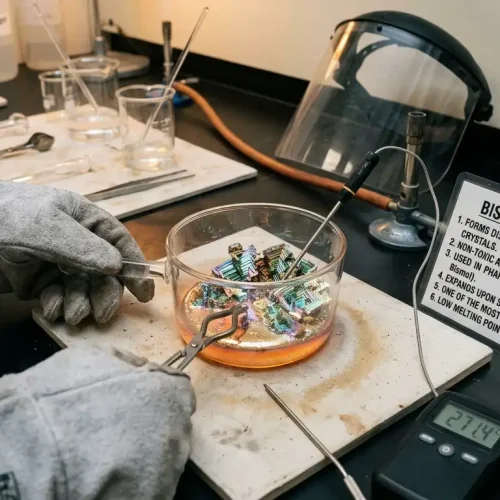
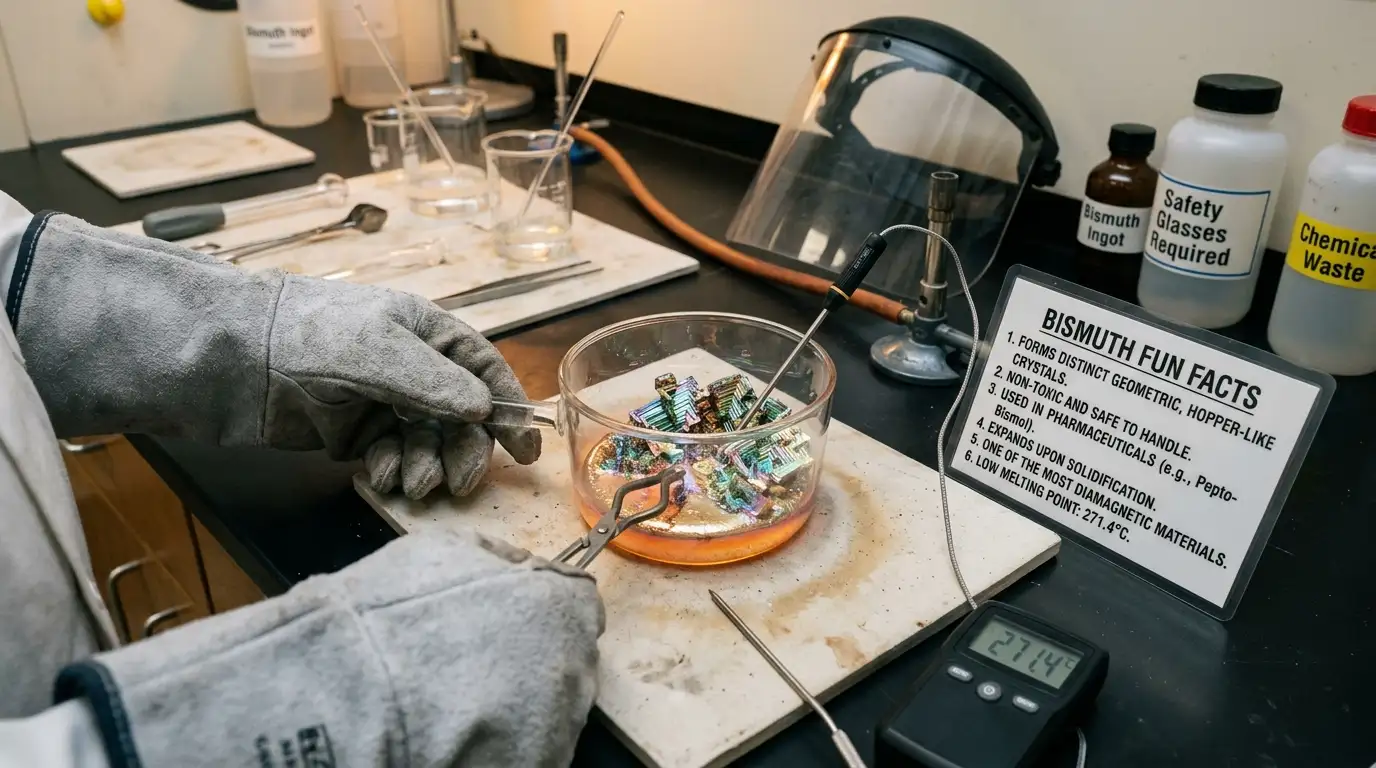
Bismuth is a fascinating post-transition metal famous for its vibrant, rainbow-colored geometric crystals and surprising everyday uses. Despite being a heavy metal, it is non-toxic, mildly diamagnetic, expands when it freezes, and possesses a half-life longer than the calculated age of the universe!
If you have ever stumbled across a rainbow-colored, step-pyramid crystal that looks like it belongs in an alien starship, you have likely laid eyes on element 83. These bizarre properties make exploring bismuth fun facts one of the most surprising journeys you can take through the periodic table.
While most heavy metals on the periodic table carry dangerous reputations, this remarkable element breaks almost every rule in the book. From settling upset stomachs to helping scientists explore fundamental physics, learning these bismuth fun facts will completely change how you view raw elements.
Let us explore what makes this shiny, rainbow-forming element one of the most uniquely charming substances in our world.
What Is Bismuth? The Heavy Metal That Plays by Its Own Rules
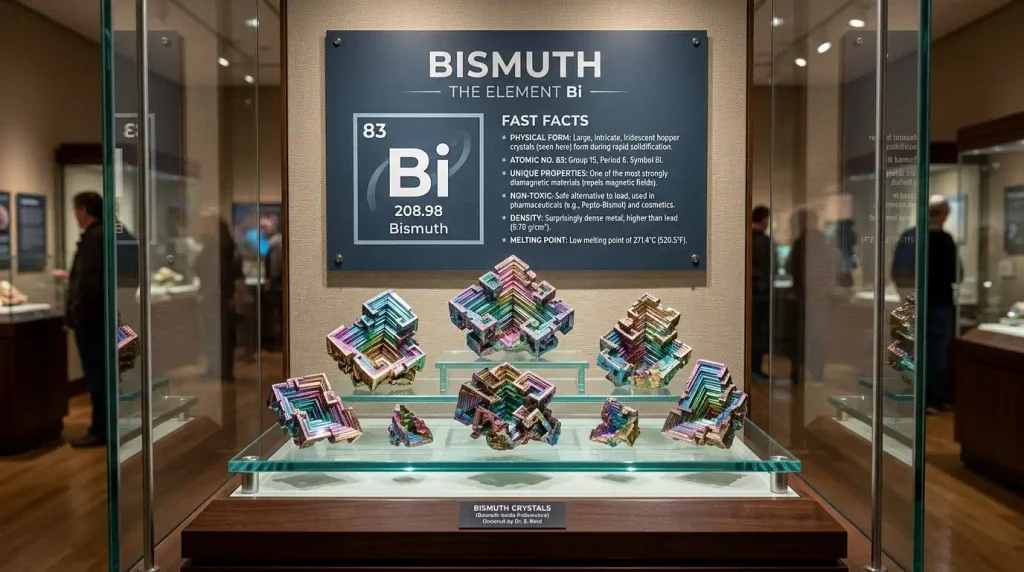
To really appreciate the weirdest bismuth fun facts, we first need to understand where this metal fits into the grand scheme of chemistry. On the periodic table, element 83 sits right next to heavyweights like lead, polonium, and thallium.
In chemistry, location usually dictates behavior. Elements living in the heavy bottom corner of the periodic table are traditionally notorious for being toxic, highly dense, and chemically dangerous. However, element 83 acts like the friendly black sheep of the heavy metal family.
It is naturally a brittle, silvery-white metal with a subtle pinkish hue in its pure form. While it shares a neighborhood with dangerous elements, it exhibits remarkably low toxicity, making it safe to handle and surprisingly common in daily human life.
A Quick Glance at Element 83
- Chemical Symbol: Bi
- Atomic Number: 83
- Atomic Weight: 208.98
- Melting Point: 520.6°F (271.4°C)
- Appearance: Silvery-pink metal naturally, rainbow iridescent when oxidized artificially.
The Ultimate List of Bismuth Fun Facts
1. The Famous Rainbow Colors Are Actually an “Accident”
When most people search for element trivia, they are drawn in by stunning photos of iridescent, technicolor metal crystals. However, pure raw metal mined from the earth is actually plain silvery-white.
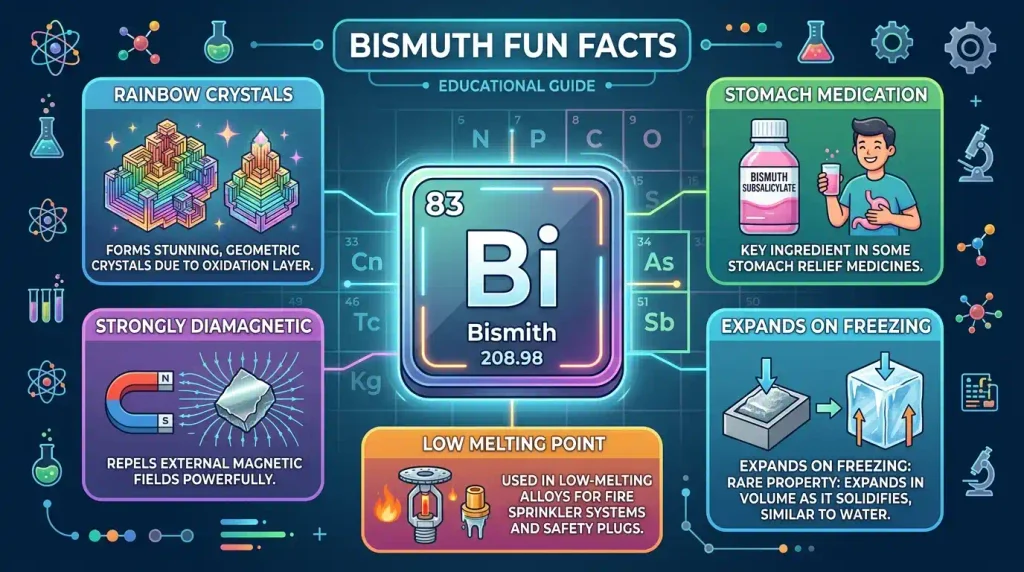
That jaw-dropping rainbow appearance is caused by a thin layer of bismuth oxide that forms when the molten metal comes into contact with air. As the liquid metal cools, oxygen reacts with the hot surface, creating a microscopic protective oxide coating.
This thin film acts like a tiny prism through a process called thin-film optical interference. Light waves bounce off both the outer surface of the oxide layer and the metal underneath, creating brilliant interference patterns that appear as vivid hues of pink, blue, gold, and green.
2. It Grows in Bizarre “Hopper” Crystals
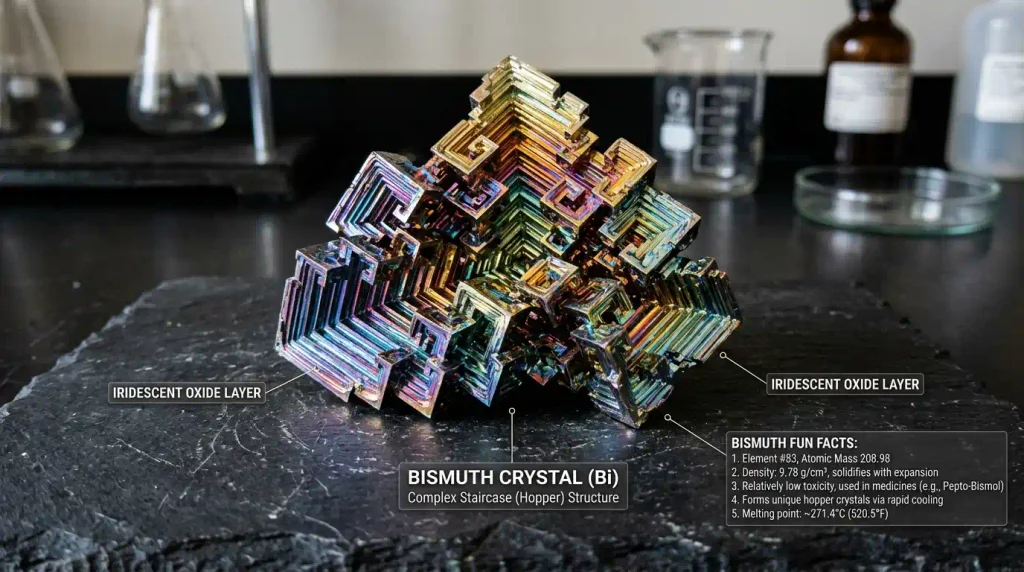
Have you ever wondered why these rainbow specimens look like tiny, intricate staircases? This unusual staircase-shaped structure is known in geology as a “hopper crystal.”
Hopper growth happens because the outer edges of the forming crystal grow much faster than the inner faces. As the liquid metal cools down, electrical charges attract atoms to the outer corners first.
This uneven growth rate leaves hollowed-out, stepped depressions that resemble ancient Mesoamerican pyramids. It is one of the very few metals on Earth that regularly forms these mesmerizing geometric shapes when allowed to cool slowly in a controlled environment.
3. It Expands When It Freezes Just Like Water
Almost every substance in the universe shrinks and grows denser as it transitions from a liquid to a solid state. Bismuth is one of the rare exceptions to this fundamental physical rule.
When molten element 83 cools down and solidifies, it actually expands by roughly 3.3 percent in volume. Water is famous for doing this when turning into ice, but seeing a heavy metallic element do it is exceptionally rare.
This expansion property makes it incredibly useful for metal casting and crafting custom alloys. When poured into a tight mold, the expanding metal pushes firmly into every microscopic groove and crevice, producing amazingly sharp, precise metal castings for intricate artistic or industrial parts.
4. It Is the Highest-Atomic-Number Stable-ish Element
For generations, chemistry textbooks clearly stated that element 83 was the absolute heaviest stable element in existence. Any element with an atomic number higher than 83 was known to be strictly radioactive and prone to rapid decay.
In 2003, French researchers made a groundbreaking discovery that shocked the scientific world. They proved that its primary isotope, Bismuth-209, is technically radioactive, meaning it eventually decays via alpha emission over time.
However, you do not need to worry about radiation hazards. The decay rate is so incomprehensibly slow that scientists consider it virtually stable for all practical everyday purposes.
5. Its Half-Life Is Longer Than the Age of the Universe
To put its subtle radioactivity into perspective, we have to look at its calculated half-life. The half-life of Bismuth-209 is estimated to be roughly 1.9 × 10¹⁹ years—or 19 billion billion years!
To wrap your head around that colossal number, the universe itself is estimated to be around 13.8 billion years old. That means its half-life is over a billion times longer than the total age of our entire cosmos.
If you lumped this metal sitting on your desk today, you would have to wait billions of lifetimes just to observe a single atomic decay event inside it.
6. It Repels Magnets Like a Champ
Have you ever held a magnet near a chunk of metal and expected it to snap into place? If you try that with element 83, you will actually feel a subtle push in the opposite direction.
This element exhibits the strongest property of “diamagnetism” among all natural metals in existence. Diamagnetism means that when an external magnetic field approaches, the element creates its own weak opposing magnetic field to push the external magnet away.
While this repelling force is relatively weak compared to powerful permanent magnets, high-purity pieces can actually levitate tiny, powerful neodymium magnets in mid-air without using any external power sources or machinery!
7. It Holds the Record for Low Thermal Conductivity
Metals are generally famous for being great conductors of both electricity and heat. If you stick a metal spoon into hot soup, the handle warms up almost instantly.
Element 83 breaks this rule as well. Outside of mercury, it has the absolute lowest thermal conductivity of any natural metal on the periodic table.
It conducts heat extremely poorly, which means a bar of it can be hot on one end while remaining surprisingly cool to the touch on the other. This makes it a fascinating candidate for specialized thermodynamic applications and thermal insulation technology.
8. It Is the Secret Star of Pink Stomach Medicine
You might be surprised to learn that you have probably swallowed this heavy metal on purpose at some point in your life. It is the active ingredient in over-the-counter stomach treatments like Pepto-Bismol!
The bright pink liquid medication relies on a chemical compound called bismuth subsalicylate. This compound coats the stomach lining, reduces inflammation, and directly fights bad bacteria that cause indigestion, nausea, and stomach upset.
When you take it, the compound reacts with tiny amounts of sulfur in your digestive system to form bismuth sulfide. This harmless reaction is why pink stomach medicine sometimes temporarily turns your tongue or stool a dark color!
9. It Replaces Toxic Lead in Fishing and Hunting Gear
Because lead is notoriously toxic to wildlife and water supplies, governments around the world have increasingly restricted its use in outdoor recreational gear. Environmental agencies needed a dense, heavy alternative that would not poison ecosystems.
Enter element 83, the non-toxic heavy metal savior. It possesses a very high density—nearly 86% as dense as lead—without any of the severe biological toxicity risks.
Today, manufacturers use non-toxic metal alloys to create safe hunting shotgun shells, eco-friendly fishing sinkers, and plumbing fixtures that keep drinking water supplies clean and safe for everyone.
10. Alchemists Used to Confuse It With Lead and Tin
Long before modern chemistry existed, ancient miners and metalworkers routinely encountered element 83 deep underground. However, because early scientific tools were limited, they frequently mistook it for other common heavy metals.
Historical records show that alchemists often confused it with lead, tin, antimony, and even silver due to its weight and low melting point. They assumed it was simply an immature form of lead that had not finished transforming inside the Earth!
It was not until the mid-18th century that scientists like Claude François Geoffroy definitively proved that it was a unique chemical element with its own distinct properties.
Bismuth Physical and Chemical Properties

Bismuth is a fascinating post-transition metal (atomic number 83) that sits between lead and polonium on the periodic table, yet behaves in remarkably unique ways. Unlike its toxic neighboring heavy metals, bismuth is strikingly non-toxic, making it an eco-friendly substitute in plumbing solders, cosmetics, and stomach medications like bismuth subsalicylate. It boasts remarkable physical characteristics—such as expanding as it solidifies and exhibiting the strongest diamagnetism of any elemental metal—alongside a distinct chemical profile that makes it both stable and versatile.
Distinct Physical Traits and Iridescent Crystallization
In its pure elemental form, bismuth is a dense, brittle, silvery-white metal with a subtle pinkish tint. When melted and allowed to cool slowly, it crystallizes into distinct geometric “hopper” structures featuring stair-step patterns. As the hot cooling metal reacts with oxygen in the air, a thin, microscopic oxide film forms on its surface, creating thin-film light interference that yields vibrant, iridescent rainbow colors. Bismuth has a relatively high density of $9.78\text{ g/cm}^3$ and a low melting point of $271.4^\circ\text{C}$, uniquely expanding by approximately 3.3% upon freezing.
Chemical Stability and Reactivity Profile
At room temperature, bismuth remains stable in dry air and resists reaction with water or non-oxidizing acids like cold hydrochloric acid. When heated to high temperatures, it burns with a faint blue flame to yield bismuth(III) oxide ($\text{Bi}_2\text{O}_3$). Bismuth reacts directly with halogens to form trihalides and dissolves readily in concentrated oxidizing acids, such as nitric acid ($\text{HNO}_3$), forming bismuth nitrate. It predominantly exhibits a +3 oxidation state in its chemical compounds, though it can also achieve a +5 state under strongly oxidizing conditions.
Diamagnetism and Thermal Conductivity
One of bismuth’s most remarkable physical characteristics is its extreme diamagnetism, meaning it is repelled by magnetic fields more strongly than any other metal on the periodic table. It also possesses exceptionally low thermal conductivity—second lowest among metals after mercury—and high electrical resistance. Furthermore, bismuth exhibits a pronounced Hall effect, which causes its electrical resistance to increase significantly when placed inside an external magnetic field.
How Bismuth Forms Its Iconic Rainbow Crystals
One of the most fascinating aspects of this metal is that you can actually create these geometric crystal sculptures right at home! Understanding the science behind crystal formation makes the process even more enjoyable to observe.
The Melting Process
Because the metal has a remarkably low melting point of just 520.6°F (271.4°C), you do not need an industrial furnace to melt it down. A simple stainless steel measuring cup placed over an electric stovetop burner provides more than enough heat to turn raw ingots into liquid metal.
As the metal melts, it looks just like liquid quicksilver or molten tin. A thin layer of dull slag forms on top, which must be gently scraped away using a spoon to reveal the pure, shimmering liquid metal underneath.
The Cooling and Oxidation Phase
Once the heat source is removed, the molten metal begins to cool down from the outside inward. As the liquid temperature drops, individual atoms start locking together into structured, solid lattice shapes.
This is where the magic happens. The moment the cooling metal contacts oxygen in the surrounding room air, an extremely thin film of oxidation immediately forms across its surface.
The temperature of the cooling metal dictates the exact thickness of this oxide layer:
- Thicker layers reflect longer light wavelengths, producing deep blues and purples.
- Medium layers reflect greens and bright yellows.
- Thinner layers result in brilliant pinks, magentas, and golden tones.
Because different parts of the growing crystal cool down at slightly different speeds, a single crystal will feature a beautiful spectrum of rainbow colors across its stepped edges.
Unexpected Everyday Uses for Element 83
Beyond growing pretty crystals on a desk, this versatile element quietly plays essential roles across modern industry, medicine, and technology.
Cosmetics and Beauty Products
If you have ever used pearlescent eyeshadow, shimmering nail polish, or glossy hair products, you have likely used element 83 compounds! A specific compound called bismuth oxychloride produces a silky, pearl-like shine that reflects light beautifully on skin.
Because this compound is non-toxic and gentle on human tissue, high-end cosmetic brands use it to add a luxurious shimmer to mineral makeup foundations without irritating sensitive skin.
Fire Safety and Sprinkler Systems
Remember how this metal expands when freezing and has a remarkably low melting point? Engineers utilize these exact properties to design safety components for emergency fire sprinkler systems inside modern buildings.
Special low-melting alloys—such as Wood’s metal or Rose’s metal—combine bismuth with tin and lead to create plugs that melt at precise temperatures. When a fire breaks out and ambient temperatures rise, the metal plug melts instantly, releasing water to extinguish the flames automatically.
High-Tech Superconductors and Laboratory Research
In advanced scientific research, physicists combine element 83 with copper, strontium, and calcium to create high-temperature superconductors known as BSCCO materials.
These advanced compounds can conduct electricity with zero electrical resistance at temperatures accessible using liquid nitrogen. This breakthrough helps scientists build powerful magnetic levitation trains, advanced MRI machines, and experimental quantum computing hardware.
Practice Exercise
Test your knowledge of these fascinating chemical facts by answering the ten multiple-choice questions below!
- What is the chemical symbol for bismuth?
A) Bi
B) Bm
C) Bs
D) Bt - What is the atomic number of bismuth?
A) 81
B) 82
C) 83
D) 84 - What type of element is bismuth?
A) Metal
B) Gas
C) Halogen
D) Noble gas - What color is pure bismuth typically?
A) Silver-white
B) Bright green
C) Blue
D) Yellow - What makes bismuth crystals especially interesting?
A) Their rainbow-like oxide colors
B) Their ability to float
C) Their transparency
D) Their magnetic glow - Which group of the periodic table contains bismuth?
A) Group 13
B) Group 14
C) Group 15
D) Group 16 - What is bismuth known for when it solidifies?
A) Forming colorful crystals
B) Turning into gas
C) Becoming completely transparent
D) Producing electricity - Which property is unusual about bismuth?
A) It expands when it freezes
B) It melts like ice
C) It has no atoms
D) It is naturally a gas - Bismuth has been used in some products related to which area?
A) Medicine
B) Aviation fuel
C) Glass cleaning
D) Clothing - Bismuth is located near which element on the periodic table?
A) Polonium
B) Oxygen
C) Iron
D) Gold
Answer Key
- A
- C
- A
- A
- A
- C
- A
- A
- A
- A
FAQs
Is bismuth toxic to touch or handle?
No, pure bismuth is non-toxic and safe to touch with bare hands. Unlike nearby heavy metals like lead or mercury, it does not easily absorb through the skin or accumulate dangerously inside the human body.
Can you melt bismuth crystals at home?
Yes, you can safely melt bismuth at home using a standard stove. Because its melting point is only 520.6°F (271.4°C), a basic stovetop burner and a stainless steel container provide more than enough heat.
Why does bismuth turn tongue black after taking medication?
Bismuth turns your tongue black by reacting with tiny trace amounts of sulfur present in your saliva and digestive tract. This reaction forms bismuth sulfide, a dark compound that safely washes away over a few days.
Is natural bismuth rare in the Earth’s crust?
Yes, raw natural bismuth is about as rare as silver in the Earth’s crust. It is rarely mined directly on its own and is usually recovered as a secondary byproduct during copper, lead, and tin refining.
Is bismuth magnetic?
No, bismuth is not magnetic in the traditional sense and will not stick to fridge magnets. Instead, it is strongly diamagnetic, meaning it creates a weak repelling force when brought close to strong magnetic fields.
Conclusion
Exploring these bismuth fun facts proves that nature still holds plenty of mind-bending surprises right on the periodic table. From its mesmerizing geometric hopper crystals to its incredible half-life that outlasts the cosmos, element 83 truly stands out as one of the most remarkable substances known to science.
Whether you are an avid mineral collector, a chemistry enthusiast, or simply someone who appreciates the weird wonders of our physical world, there is no denying the unique charm of this safe, colorful heavy metal. Its rare combination of beauty, practical utility, and fascinating physics ensures it will continue inspiring curiosity for generations to come.
Got a favorite element trivia point that blew your mind? Share this article with a fellow science fan or try growing your very own rainbow hopper crystal masterpiece at home today!

Ethan Danial is the creator and lead writer behind FunWhirls.com, a fun-focused platform dedicated to entertaining ideas, fascinating facts, funny moments, creative lists, and content that sparks curiosity. With a genuine love for discovering interesting and unexpected topics, Ethan enjoys turning simple ideas into engaging content that readers can enjoy, learn from, and share. His approach is centered on making every article easy to read, enjoyable, and worth coming back to.
At FunWhirls.com, Ethan Danial explores the lighter and more entertaining side of everyday life. He creates content for readers who love discovering something new, having a quick laugh, or simply taking a break from the ordinary. From curious facts to playful ideas and entertaining discoveries, Ethan aims to keep the content fresh, positive, useful, and engaging for readers of all kinds.