

Here is an unbelievable buckwheat fun fact: despite its confusing name, buckwheat is not a type of wheat or even a true grain! It is actually a nutrient-dense fruit seed related to rhubarb and sorrel. It is naturally gluten-free and packed with plant-based protein, antioxidants, and essential minerals.
Have you ever wondered why a food with “wheat” in its name has zero gluten? The absolute ultimate buckwheat fun fact is that this famous staple is not wheat at all.
In fact, it is not even a cereal grain like oats, rice, or barley. When you order a warm bowl of soba noodles or bite into fluffy galettes, you are actually eating tiny fruit seeds!
Let us explore every fascinating buckwheat fun fact, unpack its rich history, and learn why this superfood seed dominates kitchen tables across the globe.
What Is Buckwheat? The Imposter Grain Explained
When you look at buckwheat in a grocery store aisle, it certainly acts like a grain. You cook it like rice, grind it into flour, and boil it like oatmeal. However, botanically speaking, it belongs to an entirely different plant family called Polygonaceae.
The Rhubarb Connection
If you look closely at a growing buckwheat plant, you will see broad green leaves and tiny white flowers. That makes it a direct cousin of garden rhubarb and leafy sorrel!
Because we harvest and prepare its seeds like agricultural grains, food scientists classify buckwheat as a “pseudocereal.” This unique classification explains why it behaves so differently from actual grasses like wheat, rye, or barley.
Decoding the Name: Why Is It Called Buckwheat?
The story behind the name is just as quirky as the plant itself. The word comes from the Dutch phrase boekweit, which translates directly to “beech wheat.”
Early Dutch farmers noticed that the tiny triangular seeds looked identical to the nuts harvested from beech trees. Because people ground these seeds into flour just like wheat, the hybrid name stuck around for centuries.
Mind-Blowing Buckwheat Fun Facts You Never Knew
Buckwheat has spent thousands of years traveling the globe, feeding civilizations, and quietly saving ecosystems. Here are some of the most surprising truths about this powerhouse seed.
Fact 1: It Is 100% Naturally Gluten-Free
Many people avoiding gluten assume they must cross buckwheat off their shopping lists because of its name. But because it shares zero genetic DNA with true wheat, it is completely free of gluten proteins.
That makes it a total dream ingredient for anyone living with celiac disease or non-celiac gluten sensitivity. You get all the hearty, comforting texture of traditional grains without any stomach irritation.
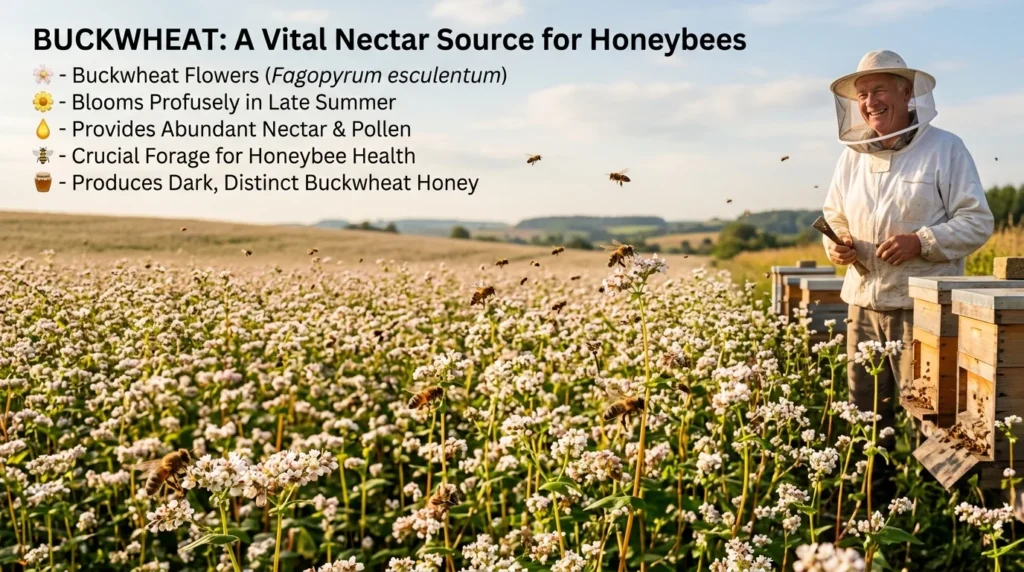
Fact 2: Bees Produce Jet-Black Honey From Its Blossoms
If you plant a field of buckwheat, local honeybees will quickly turn it into their favorite hangout spot. The plant produces fragrant white and pink blossoms that secrete vast amounts of nectar.
Beekeepers love buckwheat fields because bees transform this nectar into an exceptionally dark, rich honey. Buckwheat honey looks almost like molasses, possesses a strong earthy flavor, and packs far more antioxidants than light wildflower honey.
Fact 3: It Grows Fast Enough to Outsmart Weeds
Farmers often call buckwheat a “miracle cover crop” because of its extraordinary growth speed. While standard cereal crops require months to mature, buckwheat can reach full harvest readiness in as little as 70 to 90 days.
Its broad canopy of leaves spreads out so rapidly that it completely blocks sunlight from reaching the soil below. This natural shade smothers pesky weeds before they can take root, eliminating the need for harsh synthetic weedkillers.
Fact 4: Buckwheat Is an Ancient Asian Powerhouse
Wild buckwheat originally grew in Southeast Asia and western China thousands of years ago. Historical records show that people were cultivating it along the eastern Himalayas as early as 6000 BCE.
From there, ancient trade routes carried these hardy triangular seeds across Central Asia, through Russia, and into Europe. Today, countries like Russia, China, and Ukraine remain the world’s top producers and consumers of this ancient seed.
Fact 5: Soba Noodles Depend Entirely on It
If you enjoy authentic Japanese cuisine, you have undoubtedly devoured a bowl of delicious soba noodles. Traditional soba relies heavily on ground buckwheat flour to achieve its signature nutty flavor and earthy brown color.
In Japan, eating special soba noodles on New Year’s Eve is a cherished tradition called Toshikoshi Soba. The long, thin noodles symbolize a long, healthy life, while the easily cut texture represents severing the misfortunes of the past year.
Fact 6: The Plant Cleans and Restores Tired Soil
Buckwheat possesses unique superpowers beneath the soil line. Its fibrous root system secretes natural organic acids that dissolve insoluble phosphorus in the ground.
Once the plant absorbs this phosphorus, farmers till the crop back into the dirt. As the plant decomposes, it releases easily digestible nutrients back into the topsoil, acting as a free, highly effective natural fertilizer for future crops.
Fact 7: Millions Sleep on Buckwheat Hulls Every Night
The usefulness of this plant extends far beyond your dinner plate. After harvesting the inner kernel—known as the groat—the hard outer hulls remain.
Instead of throwing these hulls away, manufacturers fill pillows, neck cushions, and meditation mats with them. Buckwheat hull pillows conform perfectly to your head, remain cool all night, and provide excellent ergonomic support.
Fact 8: Kasha Is Just Toasted Buckwheat
If you wander into an Eastern European grocery store, you will see boxes labeled “Kasha.” While many people think kasha is a distinct plant species, it is simply raw buckwheat groats that have been roasted.
Roasting the groats completely transforms their flavor profile from mild and grassy to rich, warm, and deeply nutty. Cooking kasha with butter, onions, and broth creates a comforting staple dish enjoyed across millions of households daily.
Buckwheat vs. Common Grains: A Simple Overview

To truly understand what makes this pseudocereal special, it helps to compare it directly against the everyday grains sitting in your pantry. While true wheat, rice, and oats belong to the grass family, buckwheat breaks all the traditional agricultural rules as a flowering fruit seed. Examining these differences in plant classification, gluten content, and overall nutritional value reveals why swapping standard grains for this ancient seed can transform both your health and your cooking.
Botanical Differences: Seeds vs. Grasses
True grains like wheat, barley, rye, and rice are all cultivated seeds of cereal grasses. Buckwheat, on the other hand, comes from a broad-leafed flowering plant closely related to garden rhubarb and sorrel. Because we harvest and cook its triangular seeds just like cereal grains, nutritionists classify it as a pseudocereal, giving it a unique biological profile compared to standard crops.
The Gluten Gap: Pure Seed Power
The biggest distinction between buckwheat and traditional grains like wheat or rye is the complete absence of gluten. Wheat relies on gluten proteins to give bread its elastic, chewy texture, but these same proteins trigger severe digestive distress for millions of people. Because buckwheat comes from a non-grass plant family, it is naturally 100% gluten-free, providing the comforting density of traditional grains without any inflammatory risks.
Superior Nutritional Density
When you stack buckwheat up against refined grains like white rice or processed wheat flour, its nutritional superiority becomes immediately clear. Buckwheat provides a rare source of complete plant protein containing all nine essential amino acids, whereas most true grains lack lysine. Additionally, it boasts higher levels of dietary fiber, complex minerals like magnesium and copper, and unique antioxidant flavonoids that standard cereal grains simply cannot match.
The Health Benefits of Adding Buckwheat to Your Diet

Now that you know every essential buckwheat fun fact, let us look at what eating these little seeds actually does for your body.
Packed With Complete Plant Protein
Unlike most plant foods, buckwheat contains all nine essential amino acids that your body cannot produce on its own. This makes it a rare source of “complete protein,” making it an ideal choice for vegans, vegetarians, and athletes.
Supports Heart Health and Circulation
Buckwheat is loaded with a potent flavonoid antioxidant called rutin. Rutin helps strengthen blood vessel walls, reduce inflammation, and improve overall circulation throughout your cardiovascular system.
Helps Regulate Blood Sugar Levels
Despite containing complex carbohydrates, buckwheat boasts a surprisingly low to medium glycemic index. It contains a specialized soluble compound called D-chiro-inositol, which helps body cells respond more efficiently to insulin and keeps blood sugar stable.
How to Cook Buckwheat at Home

Cooking buckwheat groats is just as easy as making standard white rice. Follow these simple steps to prepare a delicious batch in your own kitchen:
- Rinse the groats: Place your raw or toasted groats in a fine-mesh strainer and rinse them under cool water to remove excess dust.
- Combine water and groats: Use a simple 1:2 ratio. Combine 1 cup of groats with 2 cups of water or vegetable broth in a small saucepan.
- Simmer gently: Add a pinch of salt, bring the liquid to a rolling boil, then immediately turn the heat down to low.
- Cover and cook: Cover the pot with a tight lid and let it simmer for 13 to 15 minutes until all the liquid is absorbed.
- Fluff and serve: Remove the pot from the heat and let it rest covered for 5 minutes. Fluff with a fork and enjoy!
MCQs
Test your knowledge on everything you just learned about buckwheat!
- To which plant family does buckwheat belong?
A. Poaceae (Grasses) B. Polygonaceae (Knotweed family) C. Solanaceae (Nightshades) D. Fabaceae (Legumes) - What does the Dutch word “boekweit” mean?
A. Strong grain B. Fast seed C. Beech wheat D. Bitter fruit - How long does a typical buckwheat crop take to mature for harvest?
A. 30 to 45 days B. 70 to 90 days C. 120 to 150 days D. 200 to 240 days - Which antioxidant found in buckwheat helps strengthen blood vessels?
A. Rutin B. Lycopene C. Beta-carotene D. Resveratrol - What is “Kasha”?
A. Ground buckwheat flour B. Toasted buckwheat groats C. Raw buckwheat leaves D. Fermented buckwheat tea - Why is buckwheat considered a complete protein?
A. It contains high amounts of fat B. It contains all nine essential amino acids C. It blends easily with water D. It has zero carbohydrates - Which Japanese noodle dish traditionally relies on buckwheat flour?
A. Udon B. Ramen C. Soba D. Somon - What color is pure honey made from buckwheat nectar?
A. Pale yellow B. Bright green C. Clear white D. Dark brown/black - How do farmers use buckwheat to naturally fertilize their soil?
A. Its roots release insoluble phosphorus back into usable forms B. It attracts worms from nearby fields C. It produces high amounts of salt D. It absorbs excess rainfall - Which non-food product is commonly filled with outer buckwheat hulls?
A. Bicycle seats B. Pillows and cushions C. Winter coats D. Running shoes
Answer Key
- B
- C
- B
- A
- B
- B
- C
- D
- A
- B
FAQs
Is buckwheat safe for people with celiac disease?
Yes, raw buckwheat is completely safe for anyone with celiac disease or gluten intolerance. Because it is a fruit seed rather than a grass grain, it naturally contains zero gluten. Just make sure to purchase certified gluten-free brands to avoid cross-contamination from shared factory equipment.
Can you eat raw buckwheat groats?
Yes, you can consume raw buckwheat groats, but they are much easier to digest when soaked, sprouted, or cooked. Soaking raw groats in water softens their texture and breaks down enzyme inhibitors. Crunchy sprouted groats make a fantastic topping for yogurt, smoothies, and breakfast bowls.
What does buckwheat taste like?
Raw buckwheat has a very mild, subtle, and slightly grassy flavor profile. When the groats are toasted to make kasha, they take on an intensely warm, nutty, and rich flavor. Its earthy taste pairs beautifully with savory stews, roasted vegetables, and sweet syrups.
Is buckwheat healthier than white rice?
Yes, buckwheat generally provides significantly more nutrition than standard polished white rice. It packs higher amounts of dietary fiber, protein, essential minerals, and protective antioxidants like rutin. Additionally, it has a lower glycemic index, helping prevent sudden spikes in your blood sugar.
Why do people put buckwheat in pillows?
People fill pillows with clean buckwheat hulls because they provide firm, breathable, and ergonomic support. The hollow triangular hulls shift easily to cradle your neck while allowing air to flow freely. This natural filling keeps your head cool and comfortable throughout the entire night.
Conclusion
Uncovering every surprising buckwheat fun fact proves that you should never judge a food by its name! From its secret identity as a fruit seed related to rhubarb to its power to feed bees, restore soil, and fill ergonomic pillows, this ancient pseudocereal is a true marvel of nature.
Incorporating a new buckwheat fun fact into your daily routine is as simple as switching up your pantry. Whether you want to manage blood sugar levels, enjoy complete plant-based protein, or savor authentic Japanese soba noodles, this nutrient-dense superfood offers something wonderful for every diet.
Understanding each buckwheat fun fact also highlights how versatile and easy it is to cook at home. You can simmer raw groats like rice, toss roasted kasha into warm salads, or bake delicious gluten-free treats using ground flour.
Ready to experience these amazing benefits for yourself? Grab a bag of groats during your next grocery run, try a new recipe, and enjoy this delicious, gluten-free superfood today!

Ethan Danial is the creator and lead writer behind FunWhirls.com, a fun-focused platform dedicated to entertaining ideas, fascinating facts, funny moments, creative lists, and content that sparks curiosity. With a genuine love for discovering interesting and unexpected topics, Ethan enjoys turning simple ideas into engaging content that readers can enjoy, learn from, and share. His approach is centered on making every article easy to read, enjoyable, and worth coming back to.
At FunWhirls.com, Ethan Danial explores the lighter and more entertaining side of everyday life. He creates content for readers who love discovering something new, having a quick laugh, or simply taking a break from the ordinary. From curious facts to playful ideas and entertaining discoveries, Ethan aims to keep the content fresh, positive, useful, and engaging for readers of all kinds.