
Christianity is filled with fascinating history, unexpected traditions, and surprising daily cultural connections. Exploring Christian fun facts reveals how ancient symbols, global celebrations, unique architectural feats, and legendary historical figures shaped modern culture. These amazing details offer a fresh, engaging perspective on the world’s largest religion for readers of all backgrounds.
Have you ever wondered why we place decorated evergreen trees in our homes every December, or where famous everyday expressions actually came from?
History is packed with surprising details, and discovering Christian fun facts offers a wonderfully fresh look at traditions many of us see every single day.
Whether you love uncovering quirky historical trivia or simply enjoy learning something new, these intriguing insights will completely change how you view everyday cultural customs.
Amazing Historical Beginnings and Origins
The early centuries of church history are filled with extraordinary events, dramatic shifts, and unbelievable stories. Understanding where major traditions began gives us a whole new appreciation for how ideas spread across the ancient world.
Secret Symbols of the Early Church
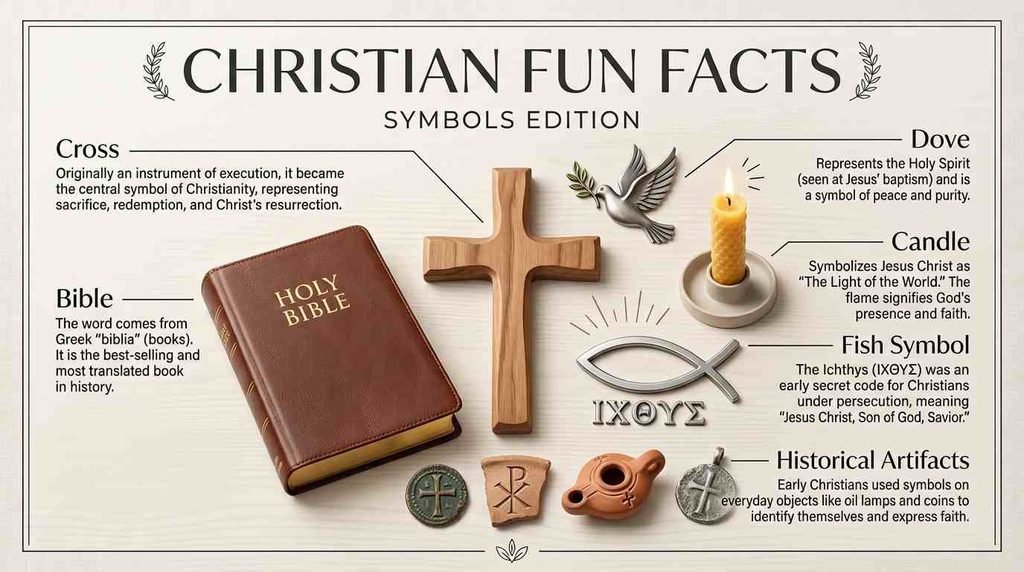
During periods of intense persecution, early believers used clever hidden symbols to communicate safely with one another. The most famous example is the simple fish outline, known historically as the Ichthys.
When two strangers met along a dusty road, one person would draw a single curved line in the dirt. If the other person was also a believer, they would draw the matching curved line to complete the shape of a fish.
Another common secret symbol was the anchor, which represented hope and stability while secretly hiding the shape of a cross.
The World’s Oldest Church Buildings
The oldest known purpose-built Christian house of worship is the Dura-Europos church, discovered in modern-day Syria. Archaeological findings reveal that this modest house church dates back to around 235 AD.
Unlike grand cathedrals built centuries later, this historic location was originally a simple residential home converted for gathering, featuring stunning wall frescoes depicting famous stories.
Today, visitors can still admire remnants of ancient architecture across the Mediterranean that showcase how early communities built lasting gathering spaces.
Fascinating Holidays and Festive Traditions
Holiday celebrations bring families together, but the origins of our favorite seasonal activities often feature unexpected twists and delightful surprises.
The Unlikely Origin of the Christmas Tree
The tradition of bringing evergreen trees indoors started in Germany during the 16th century. Devout families brought wrapped branches home to symbolize everlasting life during cold winter months.
A popular legend credits the reformer Martin Luther with being the first person to add lit candles to a tree. While walking home one winter evening, he was awed by brilliant stars twinkling through evergreen branches and wanted to recreate that magical scene for his family.
Why Easter Dates Change Every Year
Have you ever noticed that Easter never falls on the same calendar date two years in a row? This happens because the date is calculated using a lunar calendar system established way back in 325 AD at the Council of Nicaea.
- Easter is always celebrated on the first Sunday following the first full moon after the vernal equinox.
- Because the lunar cycle lasts roughly 29.5 days, the holiday can occur anywhere between March 22 and April 25.
- Eastern Orthodox traditions use the older Julian calendar, which means their celebration often occurs on a different Sunday altogether.
Surprising Bible Trivia and Record Breakers
The Bible is the most widely distributed book in human history, featuring incredible records, unique translations, and mind-boggling statistics.
The Smallest and Largest Books
Scripture contains 66 distinct books divided into two main sections, varying dramatically in length and overall structure.
- The shortest book by word count is 3 John, containing fewer than 300 words in its original Greek text.
- The longest single book is Psalms, featuring 150 individual songs, poems, and prayers.
- The shortest single verse in most English translations is John 11:35, which simply states, “Jesus wept.”
Translating Scripture into Thousands of Languages
Scripture holds the world record for the most translated text on planet Earth. Portions of the text have been translated into more than 3,500 active human languages and dialects.
Surprisingly, translators have even created official versions in constructed languages like Klingon, Esperanto, and High Valyrian to engage modern pop culture enthusiasts.
Unique Traditions Around the World
Christianity is practiced across every continent, leading to vibrant local customs that reflect diverse cultural heritages.
Giant Lantern Festivals in the Philippines
In the Philippines, the holiday season features giant glowing lanterns called parols. These magnificent star-shaped structures symbolize the star that guided travelers long ago.
Cities like San Fernando hold massive competitions where artisan craftspeople build lanterns reaching twenty feet in height, illuminated by thousands of dancing light bulbs.
Ethiopian Timkat Celebrations
In Ethiopia, the annual festival of Timkat celebrates baptism with colorful street processions, traditional drum beats, and vibrant native attire.
Participants wear snowy white woven robes called netelas while priests carry sacred ceremonial replicas wrapped in rich velvet and gold embroidery.
The Surprising History Behind Everyday Expressions
Many common phrases used in daily conversations actually originated directly from historical translations of scripture.
Phrases You Use Without Knowing It
You might be surprised by how often you quote ancient texts during normal conversations. Here are a few everyday idioms with fascinating roots:
- “A drop in the bucket” originally described something tiny compared to a vast expanse.
- “The ignorant and the blind” came from a warning about foolish guidance.
- “At my wit’s end” described travelers navigating stormy, unpredictable seas.
- “A leopard cannot change its spots” illustrated the permanent nature of human character traits.
Monumental Architecture and Engineering Marvels
From towering spires to subterranean stone chambers, religious architecture features some of the most impressive structural achievements in human history.
Churches Carved Entirely Out of Rock
In Lalibela, Ethiopia, eleven medieval churches were carved directly into solid volcanic rock during the 13th century. Builders did not construct these edifices by stacking stones; instead, they excavated massive trenches down into the earth and chiseled complete buildings out of the living bedrock.
The most famous of these, Biete Ghiorgis (House of Saint George), stands in the shape of a perfect cross, complete with carved windows, doors, and drainage systems.
The World’s Largest Cathedral
Located in Rome, St. Peter’s Basilica covers an astonishing area of over 23,000 square meters. The massive dome, designed in part by Michelangelo, reaches over 136 meters into the sky.
It took over 120 years to construct this architectural masterpiece, requiring generations of brilliant engineers, sculptors, and stone masons to complete.
Quick Facts Summary
MCQs
Test your knowledge of these incredible historical insights with this quick practice quiz.
- Christianity is based on the teachings of whom?
A) Moses
B) Jesus Christ
C) Abraham
D) David - What is the holy book of Christianity called?
A) Bible
B) Torah
C) Vedas
D) Quran - What symbol is commonly associated with Christianity?
A) Star
B) Crescent
C) Cross
D) Circle - Which day is commonly celebrated as the day Jesus rose from the dead?
A) Christmas
B) Easter Sunday
C) Good Friday
D) Palm Sunday - Christmas celebrates the birth of whom?
A) Peter
B) Paul
C) Jesus Christ
D) John - What is the first book of the Bible?
A) Exodus
B) Genesis
C) Psalms
D) Matthew - How many books are in the Protestant Bible?
A) 50
B) 66
C) 73
D) 80 - Which city is traditionally known as the birthplace of Jesus?
A) Bethlehem
B) Rome
C) Athens
D) Jerusalem - What is Good Friday associated with?
A) Jesus’ baptism
B) Jesus’ crucifixion
C) Jesus’ birth
D) Jesus’ ascension - What is the Christian celebration of Jesus’ resurrection called?
A) Easter
B) Advent
C) Lent
D) Pentecost
Answer Key
- B
- A
- C
- B
- C
- B
- B
- A
- B
- A
FAQs
What are some of the most surprising Christian fun facts?
Some of the most surprising facts include secret ancient code symbols like the fish shape, rock-hewn churches carved straight down into volcanic stone, and everyday phrases like “a drop in the bucket” originating directly from ancient translation texts.
Why is the fish shape such a famous symbol?
The fish shape, called the Ichthys, served as an ancient secret handshake. Early believers would draw one curved arch in the dirt, waiting for another person to complete the shape to safely confirm their shared identity without speaking aloud.
Who started the tradition of lighting candles on holiday trees?
Legend credits reformer Martin Luther with placing lit candles on evergreen trees during the 16th century. He wanted to capture the beauty of bright stars shining through dark pine branches for his children at home.
How many languages has scripture been translated into?
Portions of scripture have been translated into over 3,500 active global languages. That incredible total includes modern constructed languages like Esperanto, Klingon, and High Valyrian created for pop culture fans.
Where is the world’s largest church building located?
The world’s largest church building is St. Peter’s Basilica, located in Vatican City, Rome. It covers an area of over 23,000 square meters and features a soaring dome designed in part by Michelangelo.
Why does the calendar date of Easter change every year?
Easter changes dates because it is calculated using a lunar calendar system established in 325 AD. The holiday falls on the first Sunday after the first full moon following the spring equinox.
What makes the churches of Lalibela so famous?
The churches of Lalibela in Ethiopia are famous because medieval builders excavated eleven complete structures directly out of solid volcanic bedrock, chiseling windows, doors, and rooms straight downward into the earth.
Conclusion
Uncovering these fascinating Christian fun facts reveals how rich, diverse, and surprising global cultural history truly is. From secret ancient handshakes drawn in the dust to massive architectural marvels carved straight out of solid rock, these stories highlight human creativity, deep tradition, and incredible resilience across the centuries.
Exploring history with an open mind allows us to appreciate the surprising origins of everyday phrases, seasonal celebrations, and global customs we often take for granted. Next time you decorate an evergreen tree or use a classic everyday idiom, you will know the amazing story behind it.
Which surprising fact amazed you the most? Share this guide with your friends and family to spark a fun conversation today!

Ethan Danial is the creator and lead writer behind FunWhirls.com, a fun-focused platform dedicated to entertaining ideas, fascinating facts, funny moments, creative lists, and content that sparks curiosity. With a genuine love for discovering interesting and unexpected topics, Ethan enjoys turning simple ideas into engaging content that readers can enjoy, learn from, and share. His approach is centered on making every article easy to read, enjoyable, and worth coming back to.
At FunWhirls.com, Ethan Danial explores the lighter and more entertaining side of everyday life. He creates content for readers who love discovering something new, having a quick laugh, or simply taking a break from the ordinary. From curious facts to playful ideas and entertaining discoveries, Ethan aims to keep the content fresh, positive, useful, and engaging for readers of all kinds.