
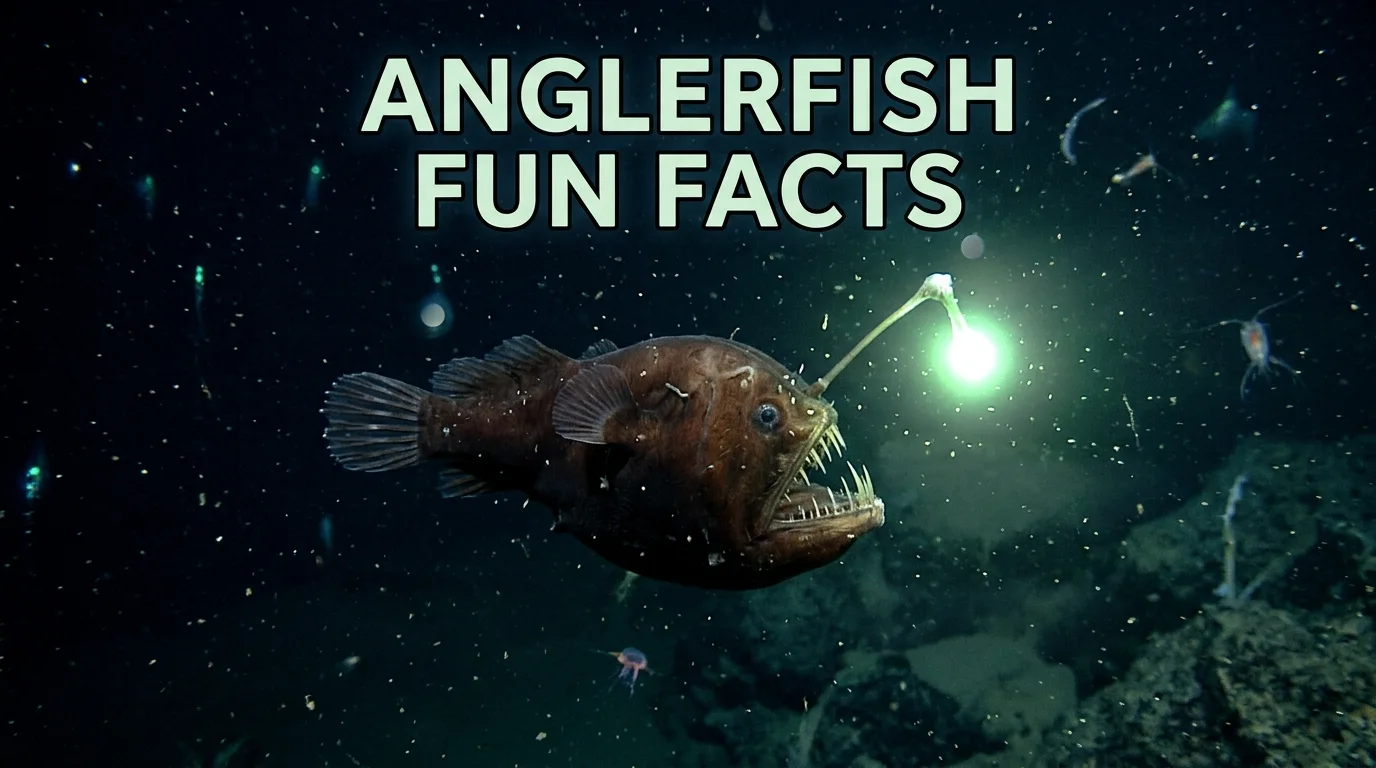
Anglerfish are deep-sea predators known for their glowing lures, extreme biological adaptations, and unique mating habits. Female anglerfish use bioluminescent bacteria to attract prey in total darkness, while parasitic males fuse directly into the female’s body to survive.
Imagine walking through a pitch-black forest with a glowing light bulb attached to your forehead, waiting for a sandwich to wander by. That is just another regular Tuesday for the anglerfish.
These bizarre deep-sea creatures live thousands of feet beneath the ocean surface, where sunlight never reaches, and temperatures stay cold. Learning these anglerfish fun facts reveals just how strange, clever, and extreme life on Earth can get.
From glowing fishing rods to parasitic husbands, let us explore the wild world of these alien-like ocean dwellers.
What Makes the Anglerfish So Unique?
The deep sea is a vast, lonely place where finding food and surviving requires incredible tricks. Anglerfish have evolved some of the most specialized survival traits of any animal on the planet.
Built for the Dark Bottom of the Ocean
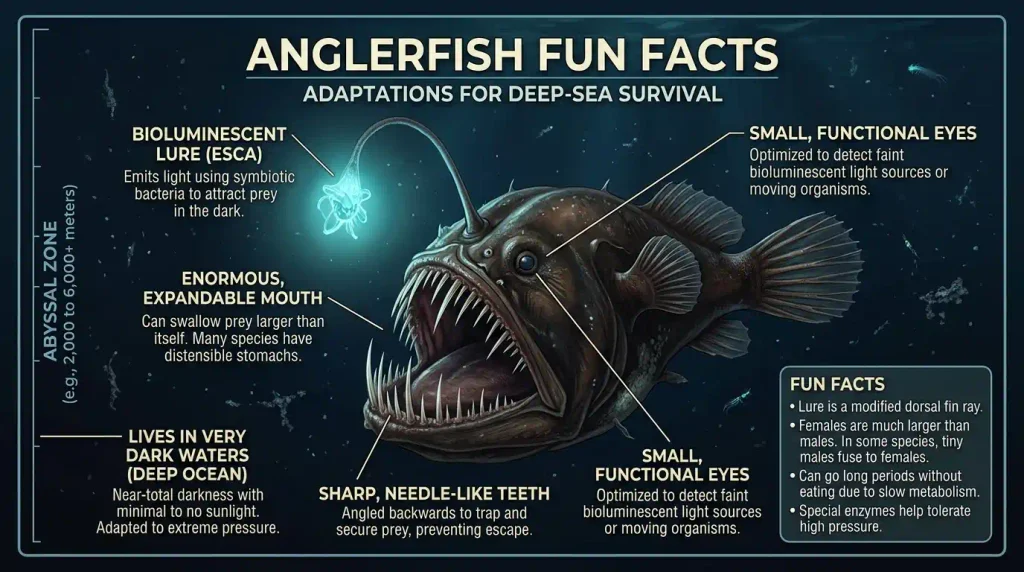
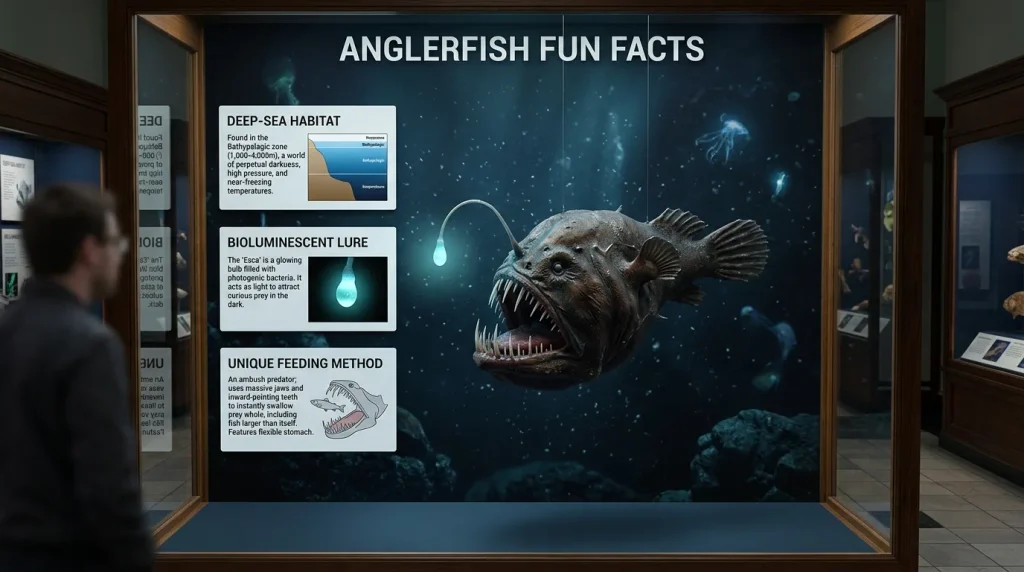
Most anglerfish species live in the bathypelagic zone, which ranges from 3,000 to 12,000 feet below the surface. Up to 99% of sunlight is filtered out before reaching these depths, leaving the region in eternal twilight or total darkness.
To survive here, anglerfish do not rely on speed or eyesight like shallow-water fish. Instead, they act as slow-moving ambush predators that let their prey come directly to them.
Over 200 Different Species Exist
When people think of an anglerfish, they usually imagine a single round creature with massive teeth. However, scientists have identified over 200 distinct species of anglerfish grouped into four main suborders.
- Deep-sea anglerfish (Ceratioidei): The most famous group, known for extreme sexual dimorphism and glowing lures.
- Frogfish (Antennariidae): Shallow-water relatives that walk on the ocean floor using modified pectoral fins.
- Sea Toads (Chaunacidae): Round, squishy fish that live on continental slopes.
- Batfish (Ogcocephalidae): Flat-bodied bottom dwellers found in warm coastal waters.
Extreme Sexual Dimorphism
In the anglerfish family, males and females look like completely different species. Females are absolute giants compared to males, often growing up to 60 times larger and weighing half a million times more.
A female deep-sea anglerfish can grow over three feet long, while the male of the same species might only measure a fraction of an inch.
The Glowing Lure: Nature’s Fishing Rod
The most famous feature of the female anglerfish is her headpiece, known as the esca and illicium. This natural fishing setup is an engineering marvel of biology.
How the Esca Actually Works
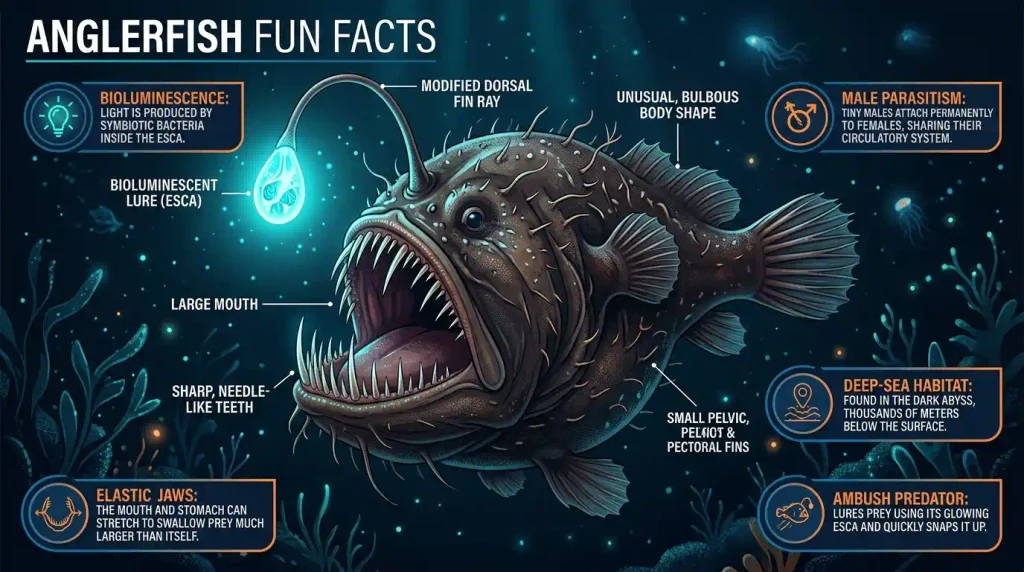
The rod itself is called the illicium, which is a modified spine from the fish’s dorsal fin. At the tip of this rod hangs the esca, a fleshy organ that glows in the dark.
The female can wiggle this rod around in front of her mouth to mimic a small worm, shrimp, or glowing organism. Hungry fish swim over to investigate the light, only to end up as dinner.
Living Bacteria Light Up the Dark
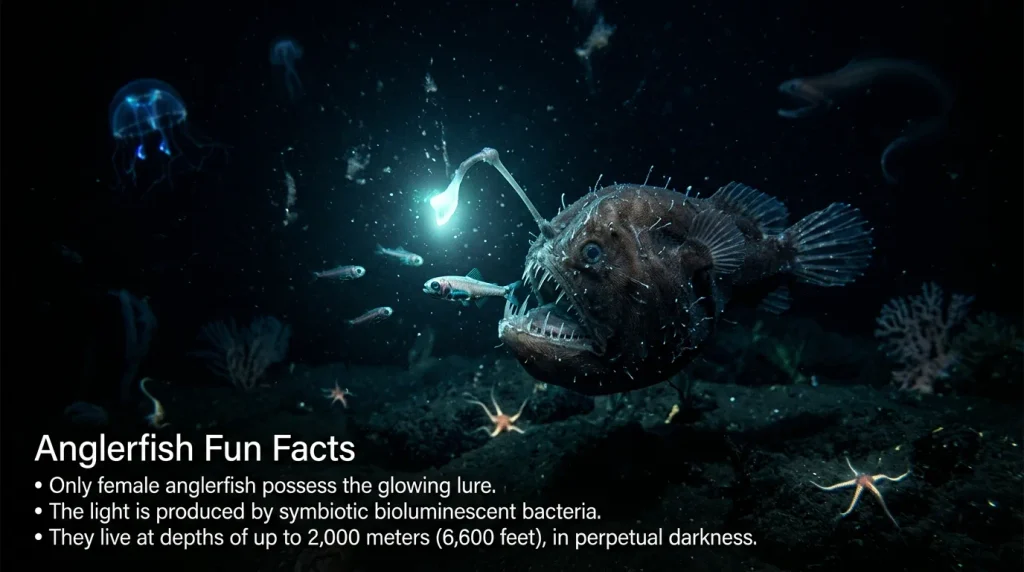
The anglerfish does not actually produce its own light through chemical reactions inside its own tissue. Instead, it relies on a symbiotic partnership with bioluminescent bacteria called Vibrio fischeri.
These bacteria live inside small chambers within the esca. The fish provides the bacteria with nutrients and protection, while the bacteria provide the glowing light needed to hunt.
Selective Control of the Light Show
Anglerfish can control when their light shines. They regulate the oxygen flow to the bacteria inside the esca, effectively turning the lamp on or off at will.
If a predator approaches, the anglerfish can instantly dim its light to blend back into the blackness of the ocean floor.
Mind-Blowing Anglerfish Fun Facts About Their Diet
Living in the deep ocean means meals are rare, so anglerfish cannot afford to be picky eaters.
Hinged Jaws and Expandable Stomachs
Anglerfish have flexible jaw joints and skin that stretches dramatically. This allows them to swallow prey that is up to twice their own size.
When a large prey item enters their mouth, their stomach expands like a water balloon to hold the meal. A single massive meal can sustain an anglerfish for several weeks or even months.
Transparent and Backward-Facing Teeth
The teeth of an anglerfish are translucent and razor-sharp, angled inward toward the back of the throat.
Once a prey item slides into the mouth, it is physically impossible for it to swim back out. The teeth act like a one-way trap door leading directly into the stomach.
Energy-Saving Predators
Anglerfish have low metabolic rates because finding food takes a lot of time. They spend most of their lives floating motionlessly in the water column to conserve precious energy.
Instead of burning calories chasing food, they let their glowing lure do all the hard work while they drift in place.
Parasitic Mating: The Strangest Relationship on Earth
Finding a mate in an empty, pitch-black ocean is nearly impossible. Deep-sea anglerfish solved this problem with a mating process so bizarre it sounds like science fiction.
Males Are Born Without Real Digestive Systems
Male anglerfish are tiny and lack the large teeth and glowing lures of females. In fact, their digestive systems stop developing shortly after they hatch.
A male anglerfish must find a female quickly, or he will starve to death within a few weeks.
Driven by an Incredible Sense of Smell
To locate a female in the vast ocean, males have giant nostrils compared to their tiny body size. They track chemical scents, called pheromones, released by females into the water.
Once a male catches the scent trail, he follows it through the pitch-black water until he finds the female.
Fusing into a Single Organism
When the male finds a female, he bites into her belly and holds on tight. Shortly after biting down, his mouth releases special enzymes that dissolve the tissue of both his mouth and her skin.
Over time, their blood vessels fuse. The male loses his eyes, fins, and internal organs, surviving entirely on nutrients supplied by the female’s bloodstream.
Multiple Husbands on One Female
A female anglerfish can carry more than one parasitic male at the same time. Some species have been found carrying up to eight fused males on their bodies.
The male remains a permanent sperm donor, ensuring the female can fertilize her eggs whenever she is ready to spawn.
Quick Comparison of Anglerfish Species
Here is the detailed paragraph for that section, followed by the three H3 subheadings with clear, reader-friendly content.
The anglerfish family is far more diverse than most people realize, spanning everything from lightless ocean trenches to sunlit coral reefs. While deep-sea species rely on glowing lures in complete darkness, their shallow-water relatives use intricate camouflage to blend into sea floors and sponges. Comparing these species highlights how remarkably adaptable the anglerfish body plan really is across different ocean depths and environments.
Humpback Anglerfish: The Iconic Deep-Sea Hunter
The Humpback Anglerfish (Melanocetus johnsonii) is the classic species most people picture when they think of deep-sea monsters. Living up to 6,000 feet below the surface, females feature a round, dark body, a massive mouth full of translucent teeth, and a bioluminescent lure hanging right over their eyes. Despite their terrifying appearance in photos, females only grow to about seven inches long, while the tiny males reach less than an inch.
Warty Frogfish: Master of Shallow Reef Camouflage
Unlike its deep-sea cousins, the Warty Frogfish (Antennarius maculatus) lives in warm, shallow coastal waters up to 300 feet deep. Instead of swimming, this species uses its modified pectoral fins to “walk” across the ocean floor and coral reefs. Its skin is covered in bumpy growths that mimic sea sponges and algae, allowing it to stay completely invisible to passing prey until it strikes with lightning speed.
Deep-Sea Fanfin: The Whiskered Wonder of the Abyss
Found at extreme depths of up to 10,000 feet, the Deep-Sea Fanfin (Caulophryne jordani) takes sensing prey to a whole new level. Unlike other deep-sea anglerfish, it does not have a glowing bioluminescent lure. Instead, its body and fins are covered in long, delicate, thread-like filaments that act like underwater cat whiskers, detecting the slightest vibrations and water movements made by swimming prey in total darkness.
How Anglerfish Handle Extreme Pressure
The deep ocean exerts crushing water pressure that would easily and instantly flatten a human being or a steel submarine.
No Gas Bladders
Most shallow-water fish rely on gas-filled swim bladders to stay buoyant and float at specific depths. If a fish with a swim bladder goes too deep, the air compresses and collapses the bladder.
Anglerfish do not have gas bladders. Instead, their bodies are filled with watery tissues and fluid that match the pressure outside, keeping them from being crushed.
Soft, Flexible Bones
Anglerfish skeletons are made of lightweight, flexible cartilage rather than dense bone.
This soft structure allows their bodies to withstand thousands of pounds of pressure per square inch without snapping or suffering structural damage.
Defensive Mechanisms: Surviving the Deep
Even in the deep ocean, anglerfish are not at the top of every food chain. They must defend themselves against larger deep-sea sharks, squid, and larger predatory fish.
Master Camouflage Techniques
Many shallow-water species, like frogfish, can change their skin color and texture to look exactly like surrounding rocks, algae, or coral reefs.
Deep-sea species are usually colored jet-black or dark reddish-brown. Since red light waves do not penetrate deep water, red fish appear completely invisible in the dark.
Expanding Like a Football
If threatened, some species can gulp in large amounts of water to swell their bodies up like a spiky balloon. This makes them look too big and intimidating for a predator to swallow.
Practice Exercise (10 MCQs)
Test your knowledge about these fascinating ocean creatures with these ten multiple-choice questions.
- Where do anglerfish commonly live?
A) Deserts
B) Deep ocean
C) Forests
D) Rivers - What is the special glowing part of an anglerfish called?
A) Fin
B) Lure
C) Scale
D) Gill - Why does an anglerfish use its glowing lure?
A) To attract prey
B) To fly
C) To keep warm
D) To communicate with birds - What does an anglerfish mainly eat?
A) Grass
B) Deep-sea animals
C) Fruits
D) Leaves - Why are anglerfish well suited to deep water?
A) They can live in very dark environments
B) They need sunlight
C) They live on land
D) They have wings - What is unusual about an anglerfish’s mouth?
A) It is very small
B) It is large with sharp teeth
C) It has no teeth
D) It is shaped like a beak - What is bioluminescence?
A) Producing light
B) Producing sound
C) Changing color only
D) Growing larger - Which sense can be especially useful for an anglerfish in dark water?
A) Smell
B) Sight only
C) Hearing only
D) None - What makes the anglerfish famous?
A) Its glowing lure and unusual appearance
B) Its colorful feathers
C) Its ability to walk on land
D) Its large wings - Why is the deep ocean a challenging habitat?
A) It has bright sunlight
B) It is dark and has high pressure
C) It has lots of trees
D) It is very dry
✅ Answer Key
- B
- B
- A
- B
- A
- B
- A
- A
- A
- B
FAQs
Are anglerfish dangerous to humans?
No, anglerfish are not dangerous to humans. Most deep-sea anglerfish live thousands of feet below the surface, far beyond human diving depths. Shallow-water frogfish are small, non-aggressive, and pose no threat to swimmers or scuba divers.
Can anglerfish survive in shallow water?
Deep-sea anglerfish cannot survive in shallow water. Their bodies are specially adapted to high hydrostatic pressure and cold temperatures. Bringing them to the surface causes temperature shock and severe tissue damage due to the lack of pressure.
Why do anglerfish teeth turn backward?
Anglerfish teeth curve backward toward the throat to trap live prey inside their mouths. Once a fish enters, it cannot swim backward past the sharp, angled teeth, ensuring the anglerfish does not lose a rare meal.
Do all anglerfish have glowing lures?
No, not all anglerfish have glowing lures. While female deep-sea species possess bioluminescent lures powered by bacteria, shallow-water species like frogfish have non-glowing lures that look like small worms or shrimp to trick prey during the day.
How long do anglerfish live?
The exact lifespan of deep-sea anglerfish remains uncertain due to the extreme difficulty of studying them in their natural habitat. However, scientists estimate that females can live for 30 years or more in the slow-paced deep ocean.
Can an anglerfish turn off its light?
Yes, an anglerfish can control its light output. By cutting off the oxygen supply to the glowing bacteria residing inside the lure, the female can dim or turn off the light completely to hide from larger predators.
Conclusion
Exploring these anglerfish fun facts shows just how creative nature can be when faced with harsh environments. From using glowing bacteria as fishing bait to fusing bodies for survival, anglerfish prove that life finds a way to thrive in the darkest corners of our planet.
Understanding these creatures reminds us of how much mysterious ocean life remains unexplored beneath the waves. Share these amazing facts with your fellow ocean lovers and keep exploring the wonders of marine life!

Ethan Danial is the creator and lead writer behind FunWhirls.com, a fun-focused platform dedicated to entertaining ideas, fascinating facts, funny moments, creative lists, and content that sparks curiosity. With a genuine love for discovering interesting and unexpected topics, Ethan enjoys turning simple ideas into engaging content that readers can enjoy, learn from, and share. His approach is centered on making every article easy to read, enjoyable, and worth coming back to.
At FunWhirls.com, Ethan Danial explores the lighter and more entertaining side of everyday life. He creates content for readers who love discovering something new, having a quick laugh, or simply taking a break from the ordinary. From curious facts to playful ideas and entertaining discoveries, Ethan aims to keep the content fresh, positive, useful, and engaging for readers of all kinds.