Botswana is a fascinating landlocked nation in Southern Africa known for housing the world’s largest elephant population, the breathtaking Okavango Delta, and the vast Kalahari Desert. It stands out globally for its stable democracy, rich cultural heritage, thriving wildlife conservation projects, and unique currency named after precious rainwater.
Have you ever wondered what makes a landlocked African nation one of the most successful and peaceful countries on the planet? If you love discovering incredible safari secrets and surprising geographic quirks, exploring these Botswana fun facts will instantly trigger your wanderlust.
Botswana offers a rare blend of booming modern stability and wild, untouched nature. Learning these surprising Botswana fun facts helps you see how nature, people, and wildlife live together in harmony.
Let us get started on this exciting journey through Southern Africa!
Geography and Wildlife Marvels of Botswana
Botswana rests right in the center of Southern Africa, surrounded by South Africa, Namibia, Zambia, and Zimbabwe. It has no ocean coastline, yet it features some of the richest water habitats on Earth.
The landscape varies drastically across the country. You can travel from dry, sandy deserts to lush, green riverbanks in just a short drive.
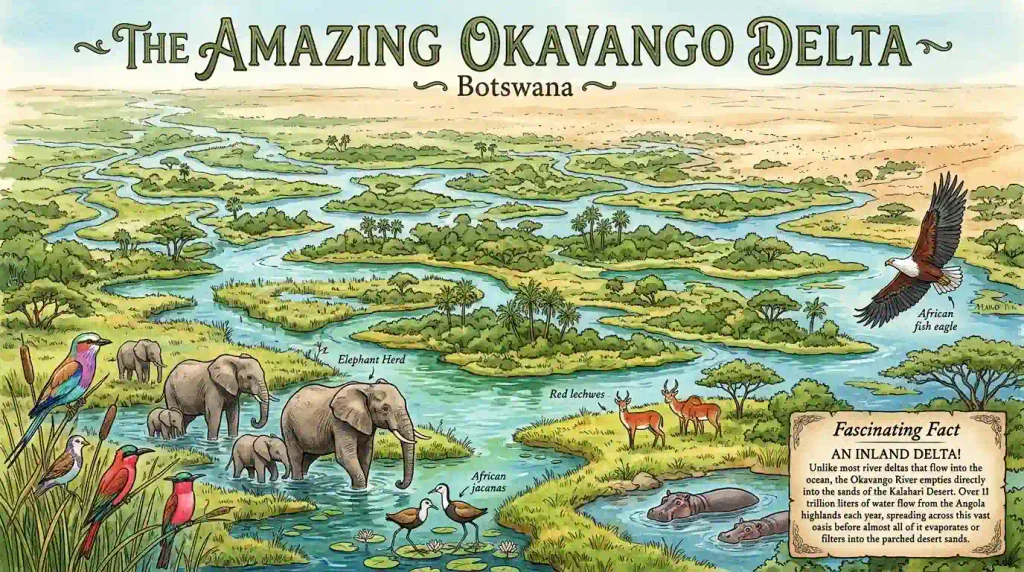
The Oasis in the Sand: Okavango Delta
Most rivers in the world empty into oceans or seas. The Okavango River is completely different because it empties into open land.
It spills into the dry sand of the Kalahari Desert every year. This creates a massive inland oasis filled with channels, lagoons, and islands.
- Millions of tons of water flow down from Angola every year to feed this delta.
- The water creates seasonal wetlands that attract thousands of wild animals.
- It is recognized as one of the Seven Natural Wonders of Africa.
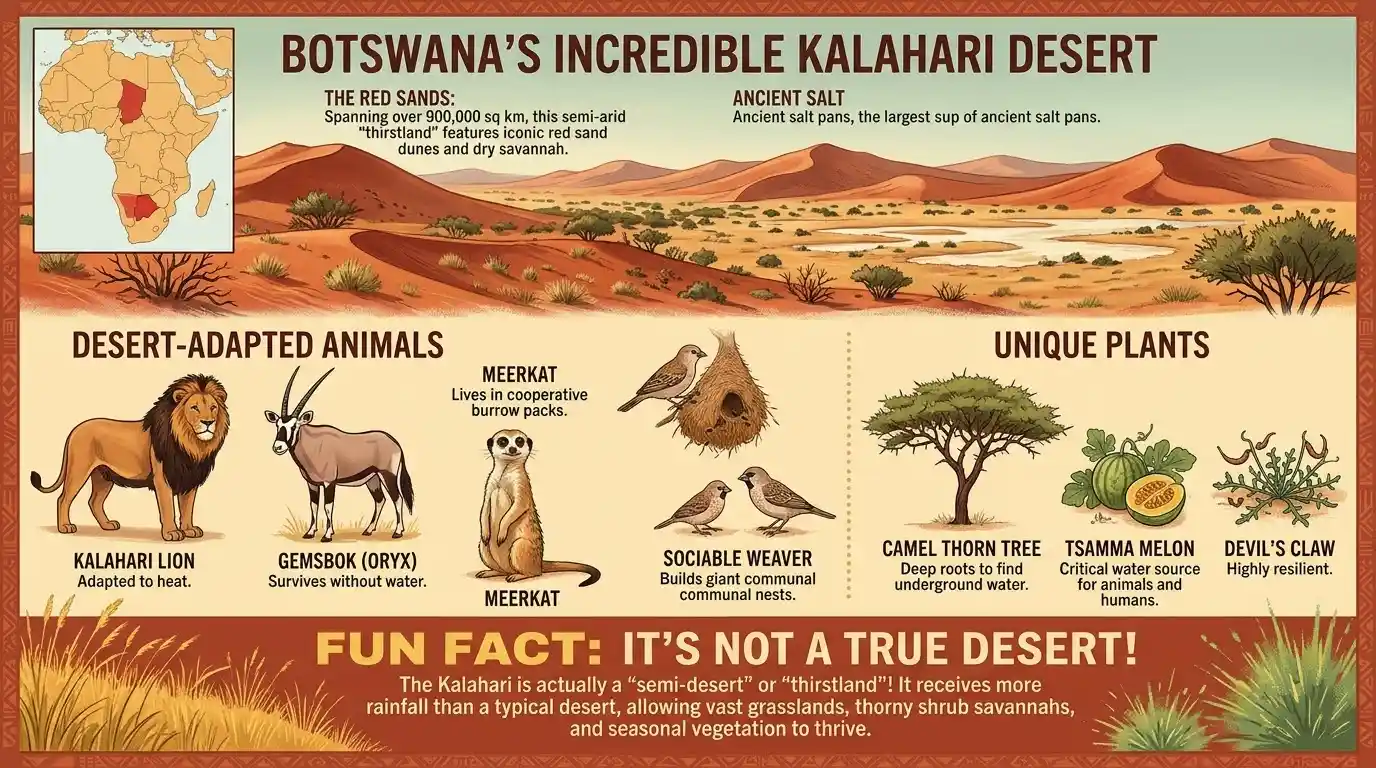
The Wild Kalahari Desert Cover
The Kalahari Desert covers roughly 70 percent of Botswana’s total land area. However, it is not a pure sand desert like parts of northern Africa.
It is actually a semi-desert with grass, bushes, and scattered trees. Animals thrive here because plants grow after seasonal rains.
A Land of Giants: Home of the World’s Elephants
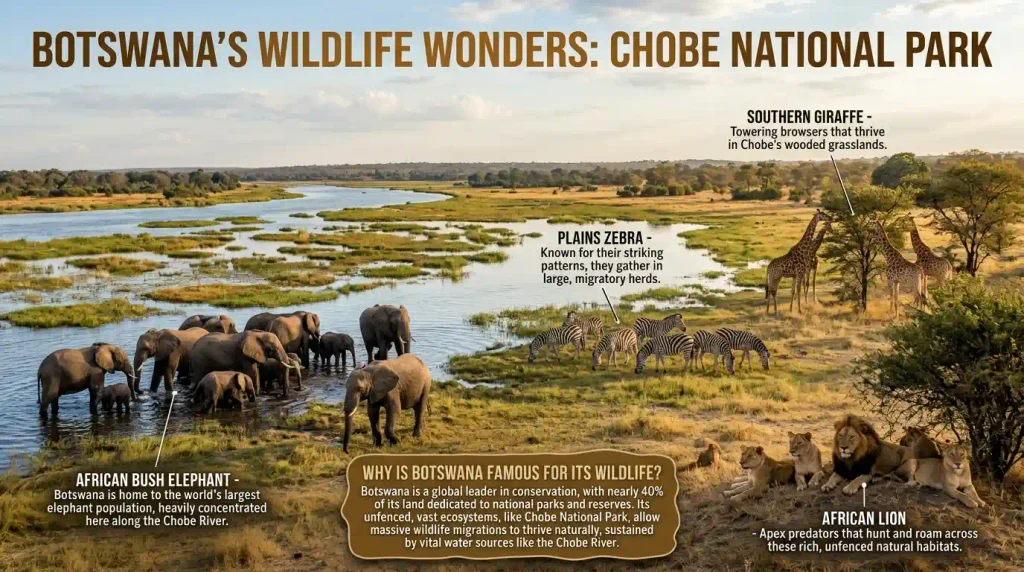
Botswana shelters the highest population of wild elephants anywhere on Earth. Estimates show that over 130,000 African elephants call this country home.
Chobe National Park is the best place to witness these giant mammals. You can see herds numbering in the hundreds drinking along the riverbanks during hot afternoons.
The Makgadikgadi Salt Pans
Imagine standing on a surface so flat and empty that you can see the curvature of the Earth. That is what visiting the Makgadikgadi Salt Pans feels like.
These pans were once a massive prehistoric lake that dried up thousands of years ago. Today, they form one of the largest salt flat complexes in the world.
During dry seasons, the pans resemble a bright white desert. When rain arrives, they turn into shallow lakes that attract thousands of pink flamingos.
Unique Currency and Economic Success
Botswana has one of the most inspiring economic stories in modern history. It transformed from one of the poorest nations in the 1960s into a prosperous middle-income economy.
Money Named After Rain
In a dry climate, rain is treated like precious gold. Botswana named its official currency the Pula, which literally translates to “rain” in the local Setswana language.
- The smaller currency units are called Thebe, which means “shield.”
- When people greet each other or celebrate, they often shout “Pula!” as a sign of good fortune.
- Rain represents wealth, prosperity, and life across the entire nation.
The Diamond Capital of the World
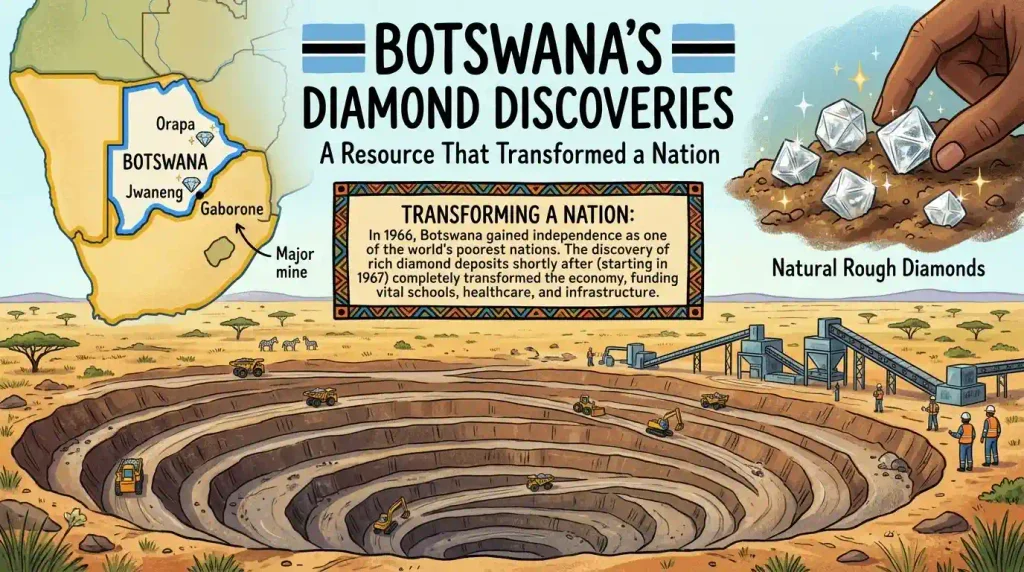
Botswana is the world’s leading producer of diamonds by overall monetary value. Shortly after gaining independence, massive diamond pipes were discovered underground.
Instead of causing conflict, diamond revenues were invested back into public infrastructure. Roads, schools, and hospitals were built across the entire country using diamond funds.
The Jwaneng mine in southern Botswana is widely considered the richest diamond mine on Earth.
A Model of Political Stability
Since gaining independence from Britain in 1966, Botswana has maintained an unbroken streak of democratic governance. It is officially Africa’s oldest continuous democracy.
This stability makes it one of the safest destinations for international travelers. Crime rates remain remarkably low compared to neighboring regions.
Rich Culture and Vibrant Heritage
The people of Botswana are known as Batswana (plural) or Motswana (singular). Their culture emphasizes community peace, mutual respect, and oral tradition.
The Power of Kgotla Meetings
Traditional decision-making happens at a communal meeting place called a Kgotla. Anyone in the community can step forward and share their opinion during these gatherings.
- Leaders use the Kgotla to listen to citizens’ concerns before making big laws.
- It is a historical form of direct democracy that continues today.
- Guests must show respect by dressing neatly and waiting for their turn to speak.
Traditional Food and Dishes
Food in Botswana is simple, hearty, and full of natural flavor. Sorghum and maize meal serve as the main base for most daily meals.
Seswaa is the national dish of Botswana. It consists of slow-cooked beef or goat meat pounded with salt until soft.
Another popular food item is the mopane worm, which is a caterpillar harvested from local trees. They are dried or fried with tomatoes and onions for a crunchy, high-protein snack.
The Art of Ostrich Eggshell Jewelry
San people have lived in the Kalahari region for tens of thousands of years. They developed incredible survival skills and artistic methods using natural resources.
They craft beautiful beads by breaking ostrich eggshells into tiny round discs. These beads are strung together to form neckpieces, headbands, and traditional waist belts.
Fascinating Wildlife Highlights
Wildlife protection is built directly into Botswana’s national laws. More than 35 percent of the country’s total land is dedicated to national parks and game reserves.
The Great Zebra Migration
When thinking of animal migrations, most people picture the Serengeti. However, Botswana hosts Africa’s second-largest land mammal migration.
Thousands of zebras travel hundreds of miles between the Okavango Delta and the salt pans each year. They follow fresh grass growth caused by seasonal rainfall patterns.
Protecting the African Wild Dog
African wild dogs are heavily endangered across the continent. Botswana has become one of the last strongholds for these social hunters.
Pack-oriented social structures allow wild dogs to hunt with high success rates. Visitors often spot them roaming freely inside Moremi Game Reserve.
Black-Maned Kalahari Lions
Lions living in the desert have adapted specifically to survive harsh environmental conditions. They are generally larger than typical lions and feature distinctive dark manes.
These lions cover huge distances in search of prey. Their dark manes help attract mates while serving as a symbol of peak health in dry climates.
Modern Innovations and Eco-Tourism Leaders
Botswana does not treat travel like a high-volume business. Instead, it focuses on high-value, low-volume eco-tourism to preserve natural environments.
Low-Impact Tourism Model
To protect wilderness areas from pollution, Botswana intentionally limits tourist capacity. Safari lodges are designed to leave zero physical footprint on the environment.
- Permanent building structures are prohibited inside core wilderness zones.
- Lodges run almost entirely on solar power systems.
- High visitor fees directly support local community conservation programs.
The Border Paradox: The Kazungula Quadripoint
Botswana features one of the most unusual international borders in world geography. Near the town of Kasane, four countries almost touch at a single river point.
Botswana, Zambia, Zimbabwe, and Namibia meet along the Zambezi River. Travelers can cross from Botswana into Zambia using the modern Kazungula Bridge in just a few minutes.
Solar Energy Pioneer
With over 300 sunny days every year, Botswana is rapidly adopting clean solar technology. Rural safari camps generate power using off-grid solar farms.
This initiative keeps diesel generator noise away from wild animals. It allows guests to listen to nighttime nature sounds without engine interruptions.
Everyday Life and Fun Facts for Travelers
Visiting Botswana is a smooth experience for global tourists. English is widely spoken across schools, businesses, and safari operations.
Gentle Greetings Matter Most
Politeness is deeply woven into daily interactions. When meeting someone, you should always say “Dumela” (hello) before asking a question.
Rushing directly into asking directions without greeting a local person is seen as rude behavior. Adding a friendly smile makes your conversation instant and pleasant.
No Fences in Wild Towns
In places like Kasane or Maun, wild animals walk right past public spaces. It is common to see warthogs grazing on hotel lawns or elephants walking past gas stations.
Residents learn to live calmly alongside wildlife from an early age. They treat wild animals with steady distance and quiet respect.
Incredible Birdwatcher Paradise
Botswana is home to more than 600 unique bird species. It attracts birding enthusiasts from every corner of the globe.
- The Carmine Bee-eater nests in riverbanks in thousands.
- The African Fish Eagle creates iconic calls that resound over water channels.
- The Kori Bustard, Africa’s heaviest flying bird, roams the open plains.
Ancient Rock Art at Tsodilo Hills
Located in northwestern Botswana, Tsodilo Hills is often called the “Louvre of the Desert.” It rises dramatically out of flat desert plains.
It features over 4,500 individual rock paintings created by ancient human ancestors. Some of these rock artworks are estimated to be over 20,000 years old.
Practice Exercise
Question 1: What is the official currency of Botswana?
A. Rand B. Pula C. Dollar D. Shilling
Question 2: Which animal population in Botswana is the largest in the world?
A. Lions B. Giraffes C. Elephants D. Cheetahs
Question 3: What happens to the water of the Okavango River?
A. It flows into the Atlantic Ocean B. It flows into the Indian Ocean C. It drains into the Kalahari Desert sand D. It empties into Lake Victoria
Question 4: What percentage of Botswana’s total land area is covered by the Kalahari Desert?
A. Around 20 percent B. Around 40 percent C. Around 70 percent D. Around 95 percent
Question 5: What is the national dish of Botswana made of slow-cooked meat?
A. Seswaa B. Biltong C. Injera D. Ugali
Question 6: What does the currency name “Pula” mean in Setswana?
A. Sun B. Gold C. Rain D. Diamond
Question 7: Tsodilo Hills is famous for which unique attraction?
A. Active volcanoes B. Deep river canyons C. Thousands of ancient rock paintings D. High snow peaks
Question 8: Which mineral resource led Botswana’s rapid economic growth after independence?
A. Oil B. Diamonds C. Gold D. Copper
Question 9: What is a traditional communal decision-making meeting called in Botswana?
A. Braai B. Kgotla C. Lekgotla D. Safari
Question 10: Which bridge links Botswana directly to Zambia across the river border?
A. Victoria Bridge B. Chobe Crossing C. Kazungula Bridge D. Zambezi Skyway
Answer Key
B C C C A C C B B C
FAQs
What makes Botswana unique compared to other African countries?
Botswana stands out for its stable democracy, peaceful history, and strong wildlife protection. It has the world’s largest elephant population and the famous Okavango Delta, making it a top destination for nature lovers.
Why is rain so important in Botswana’s culture?
Botswana has a dry climate, and much of the country lies in the semi-arid Kalahari region. People value rain because it brings life, health, and prosperity. The word “Pula” means rain in Setswana, and Botswana uses it as its currency name and a common national greeting.
Is Botswana a safe place for international tourists?
Yes, Botswana ranks among Africa’s safer travel destinations. Its political stability, relatively low crime rates, and welcoming people make it a comfortable place for many international visitors.
What is the best time of year to visit Botswana?
The dry season, from May to October, offers excellent wildlife viewing. Animals gather near rivers and waterholes, while thinner vegetation makes them easier to spot. The Okavango Delta also reaches its highest flood levels during this period.
What language do people speak in Botswana?
English serves as Botswana’s official language in schools, government offices, and tourist areas. Most people speak Setswana in everyday conversations.
How does Botswana protect its wildlife?
Botswana promotes low-impact tourism to protect its natural environment. More than one-third of the country’s land supports conservation, giving wildlife large areas to roam freely.
Can you see the Big Five in Botswana?
Yes, visitors can see all five animals: lions, leopards, elephants, buffaloes, and rhinos. Lions, leopards, elephants, and buffaloes live in many reserves, while protected areas such as Khama Rhino Sanctuary help safeguard rhinos.
Conclusion
Exploring these Botswana fun facts reveals a country that handles progress and nature preservation with equal skill. From the peaceful channels of the Okavango Delta to the vast salt pans of Makgadikgadi, Botswana continues to inspire travelers worldwide.
Whether you plan to visit for a dream safari or simply love expanding your knowledge of global wonders, learning these Botswana fun facts opens a window into a truly remarkable nation. The friendly culture, thriving animal herds, and pristine landscapes offer endless lessons in living alongside nature.
Are you ready to experience Botswana’s magic for yourself? Start planning your adventure today, look up travel itineraries, and prepare to discover one of Africa’s greatest success stories in person!

Ethan Danial is the creator and lead writer behind FunWhirls.com, a fun-focused platform dedicated to entertaining ideas, fascinating facts, funny moments, creative lists, and content that sparks curiosity. With a genuine love for discovering interesting and unexpected topics, Ethan enjoys turning simple ideas into engaging content that readers can enjoy, learn from, and share. His approach is centered on making every article easy to read, enjoyable, and worth coming back to.
At FunWhirls.com, Ethan Danial explores the lighter and more entertaining side of everyday life. He creates content for readers who love discovering something new, having a quick laugh, or simply taking a break from the ordinary. From curious facts to playful ideas and entertaining discoveries, Ethan aims to keep the content fresh, positive, useful, and engaging for readers of all kinds.