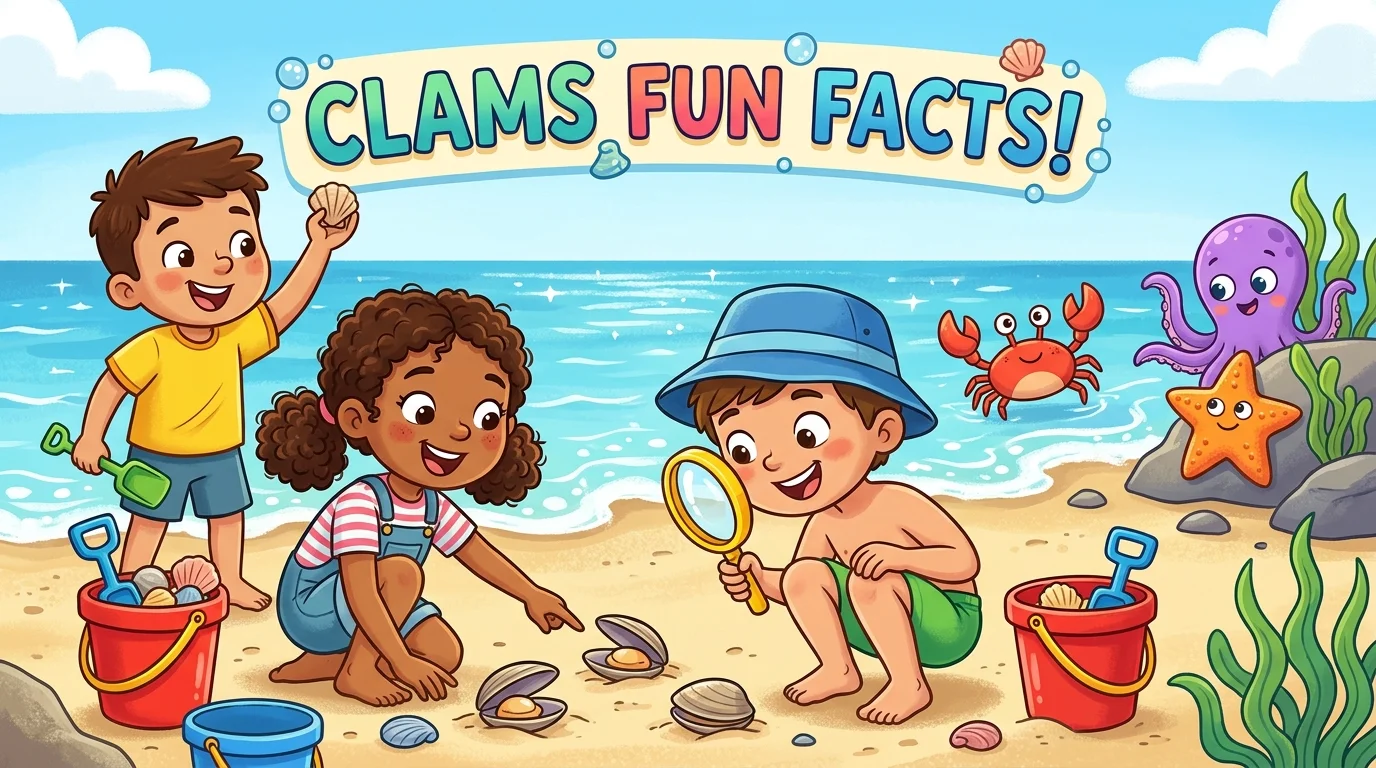
Clams fun facts reveal that these ocean mollusks are far more extraordinary than they look. Some species can live for over 500 years, grow larger than a kitchen sink, and survive without eyes or brains. They clean marine environments by filtering dozens of gallons of water daily and produce breathtaking natural pearls.
Did you know that a simple creature resting on the sandy ocean floor might actually be older than Shakespeare? Most people think of clams as nothing more than quiet shells or a delicious seafood soup ingredient, but these aquatic critters lead wild, mysterious lives.
If you have ever wondered what goes on inside those tight shells, you are in for a fun ride. These clams’ fun facts will completely change how you look at the seashore forever. Let us explore the strange, marvelous, and downright shocking habits of the underwater world’s most underrated creatures.
What Makes Clams So Extraordinary?
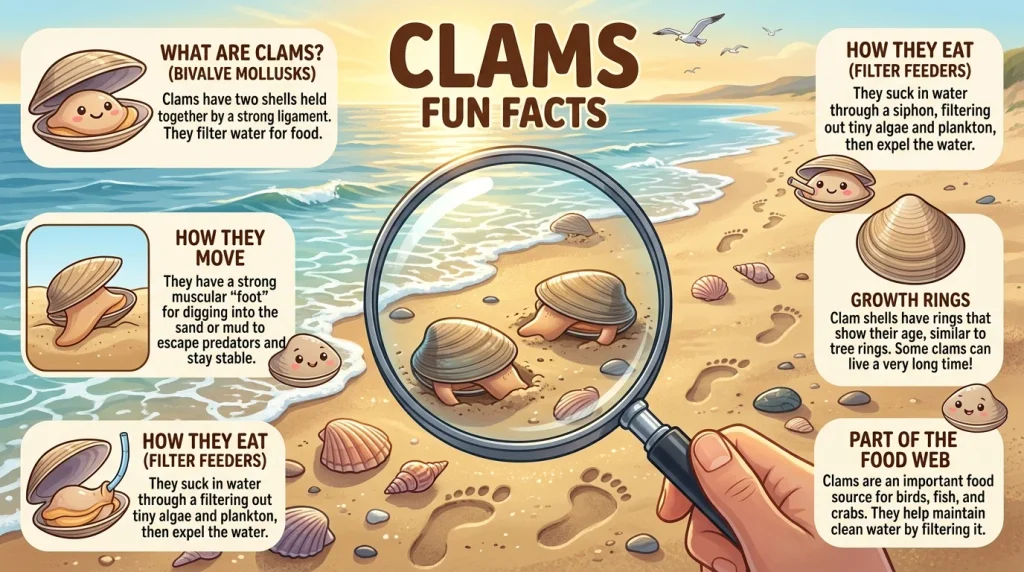
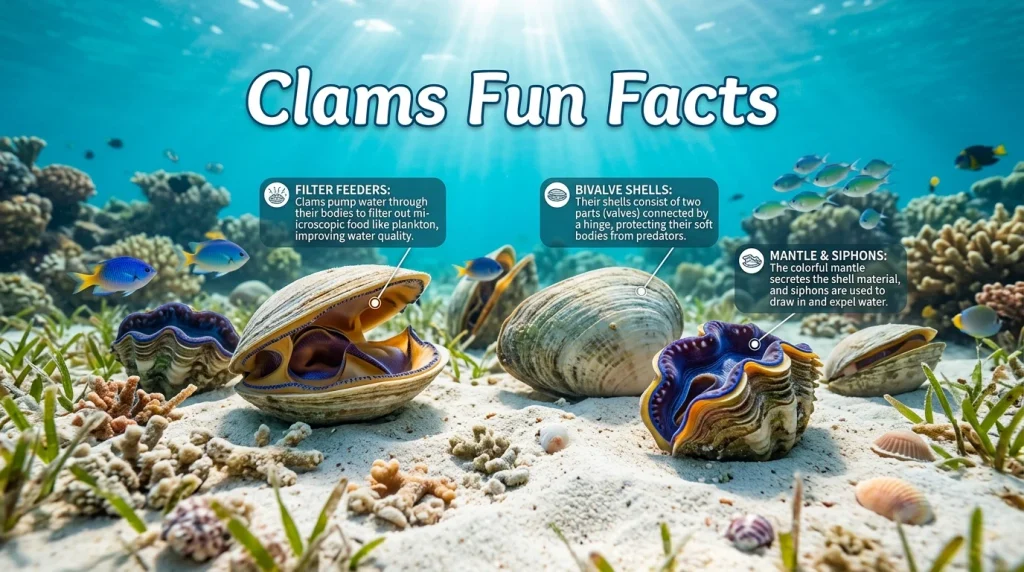
Clams belong to a special group of animals called bivalve mollusks. This means they are soft-bodied creatures protected by a hinged two-part shell that opens and closes like a tiny underwater suitcase. While they do not have faces, arms, or legs, clams have mastered ocean survival everywhere from shallow sandy beaches to dark ocean trenches.
The Basic Anatomy of a Clam
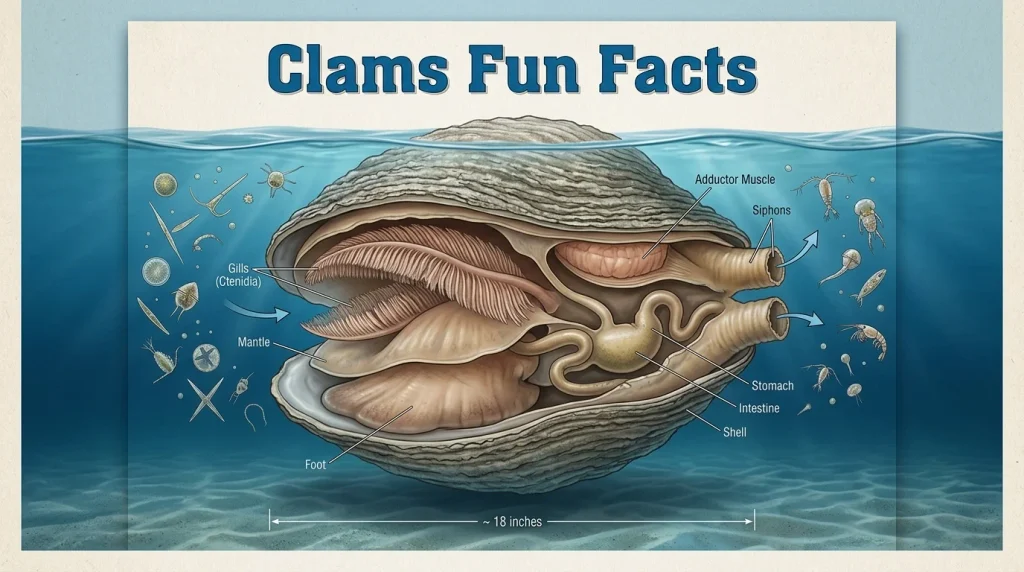
A clam is far more than just a soft blob inside a rock-hard shell. Its internal systems are surprisingly clever:
- The Mantle: This tissue wraps around the soft body and secretes minerals to build and enlarge the shell as the clam grows.
- The Foot: A muscular, tongue-like organ that sticks out to dig deep into mud or sand within seconds.
- The Siphons: Two tiny tubes that act like snorkels; one pulls water in for food and oxygen, while the other squirts waste back out.
- The Gills: Multi-purpose organs that absorb oxygen from water while filtering out tiny particles of food.
How Clams Differ From Mussels and Oysters
People often mix up clams, oysters, and mussels. While all three are bivalves, clams generally have smooth, rounded shells and live buried inside sand or mud. Mussels produce sticky threads to glue themselves to hard rocks, while oysters permanently cement their bottom shell directly to underwater surfaces.
Mind-Blowing Longevity and Growth Facts
When it comes to staying alive, clams are absolute champions. Some species living in cold waters barely age at all, outlasting almost every land animal on the planet.
The Story of Ming the Clam
In 2006, scientists off the coast of Iceland discovered an ocean quahog clam that blew researchers away. By counting the microscopic growth rings on its shell, they realized the clam was 507 years old!
- Born in 1499: This clam was alive during the Ming Dynasty, which earned it the nickname “Ming.”
- Historic Longevity: Ming was already an adult when Christopher Columbus was sailing and when the Great Wall of China was still being built.
- Cold Water Longevity: Cold ocean temperatures slow down the metabolism of these creatures, allowing them to live for centuries.
Giant Clams Can Weigh Hundreds of Pounds
While tiny clam species fit on the tip of your finger, giant clams take growth to a whole new level. Found in warm South Pacific and Indian Ocean coral reefs, a fully grown giant clam can stretch over four feet wide and weigh well over 500 pounds! Once a giant clam sets down on a coral reef, its massive weight keeps it locked in that exact spot for its entire 100-year lifespan.
Surprising Clam Behaviors and Abilities
Do not let their quiet shells fool you; clams are capable of doing some remarkably bizarre things beneath the mud.
They Move Using a Super-Powered “Foot”
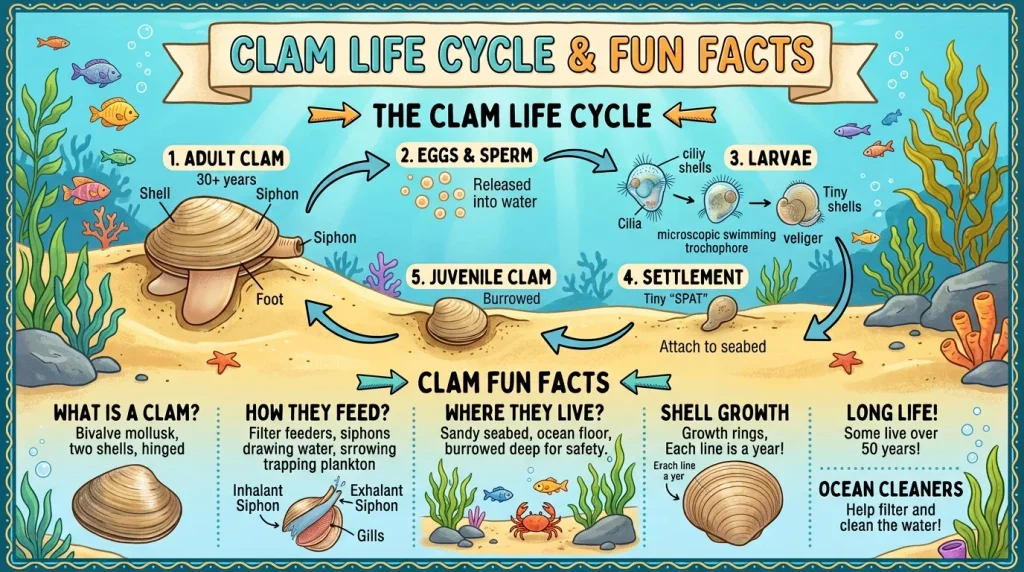
If you ever try to catch a clam at the beach, you might notice them disappearing into wet sand quickly. They accomplish this getaway move using a muscular extension known as the foot. The clam reaches its flexible foot down into wet sand, fills the tip with blood to anchor itself like an umbrella, and then pulls its heavy shell down toward the anchor point.
Clams Can Jump and Swim
While most clams prefer digging, certain species prefer flying through the water. File clams and razor clams can propel themselves across the ocean floor when a predator draws near:
- Clam Propulsion: The clam rapidly snaps its two shells together, shooting water out through tiny openings in its tissue.
- Emergency Escapes: This jet-like water propulsion bounces the clam up into the water, allowing it to escape hungry sea stars.
- Active Swimming: File clams use long, colourful tentacles extending from their shell edges to balance themselves as they swim.
How Clams Feed and Keep the Ocean Clean
Clams play a massive role in maintaining healthy coastal ecosystems. Think of them as the natural vacuum cleaners of our bays, estuaries, and oceans.
The Ultimate Ocean Water Filters
Clams are filter feeders that consume microscopic organisms like plankton and free-floating algae. To eat, they continuously draw ocean water into their shells using their incurrent siphon tube. As water flows across sticky gills inside the shell, tiny food particles get trapped and swept straight into the clam’s stomach. A single mature clam can filter up to 24 gallons of ocean water every single day!
Why Clean Water Depends on Clam Populations
Because thousands of clams sit together in massive underwater beds, their collective filtering power keeps water crystal clear. This clear water allows sunlight to penetrate deep underwater, helping essential seagrass meadows grow.
Popular Clam Species at a Glance
- Ocean Quahog: Measures 3 to 5 inches, lives between 100 and 500+ years, and is found in the cold waters of the North Atlantic.
- Giant Clam: Measures 3 to 4.5 feet, lives over 100 years, and thrives in warm South Pacific coral reefs.
- Geoduck Clam: Shell measures 7 to 9 inches with a 3-foot neck, lives 100 to 160 years, and resides in Pacific Northwest mudflats.
- Soft-Shell Clam: Measures 1 to 3 inches, lives 10 to 12 years, and sits in tidal mudflats along the Atlantic Coast.
- Pacific Razor Clam: Measures 3 to 6 inches, lives 5 to 7 years, and burrows in sandy beaches of the Pacific Coast.
Weird and Quirky Clam Species
Nature loves to get creative, and the wide variety of clam species across the world proves just how strange biological adaptation can get.
The Hilarious Geoduck Clam
Pronounced “gooey-duck,” this species is easily one of the strangest-looking sea creatures on Earth. Native to the Pacific Northwest, geoducks have a siphon neck that stretches over three feet long. Their massive body is so large that it can never pull itself completely inside its shell. They dig up to four feet into coastal mudflats, extending their giant siphons up to the water level.
The Disco Clam: Nature’s Underwater Electric Show
Deep inside Indo-Pacific reefs lives the electric flame clam, commonly known as the “disco clam.” This small creature produces a dazzling light show along the edges of its soft tissues. Scientists discovered that the clam reflects sunlight using tiny silica mirror particles inside its tissue folds, flashing like a shiny underwater disco ball to scare off hungry predators.
How Clams Produce Pearls
When most people picture shimmering natural pearls, they immediately think of wild oysters. However, clams are equally capable of creating stunning, valuable gemstones deep inside their shells.
The Defense Mechanism Behind Pearls
A clam creates a pearl to protect its sensitive body from harm:
- Irritant Entrance: A speck of sharp sand, parasite, or shell fragment gets trapped inside the clam’s soft mantle tissue.
- Soothe the Sting: The clam cannot kick the irritant out, so its body secretes smooth layers of a mineral material called nacre.
- Layering Up: Over several years, hundreds of microscopic layers harden over the trapped irritant.
- The Smooth Result: The process creates a smooth, round pearl that prevents the sharp object from damaging the clam’s soft flesh.
MCQs
- What is the verified age of Ming, the oldest known ocean quahog clam?
A. 150 years B. 300 years C. 507 years D. 820 years - How do clams propel themselves through the water to escape predators?
A. By wagging a long tail B. By rapidly snapping shells to shoot water jets C. By blowing air bubbles D. By spinning their foot - Which muscle organ does a clam use to dig deep down into wet sand?
A. The Anchor B. The Mantle C. The Foot D. The Siphon - What creates the flashing light effect inside the disco clam?
A. Glowing bacteria B. Internal electric currents C. Reflective silica mirror particles D. Chemical firefly reactions - How much ocean water can a single mature clam filter in one day?
A. Up to 2 gallons B. Up to 10 gallons C. Up to 24 gallons D. Up to 100 gallons - What material does a clam secrete to enclose an irritant and form a pearl?
A. Nacre B. Quartz C. Chitin D. Keratin - What color is clam blood when exposed to oxygen?
A. Bright red B. Pale blue C. Dark green D. Clear purple - What were quahog clam shells historically used for by Atlantic Native American crews?
A. Roof tiles B. Wampum beads for trade C. Sharpening arrows D. Musical flutes - Why do ocean quahogs in cold waters live for centuries?
A. Special deep-sea diet B. They never sleep C. Cold temperatures slow their metabolism D. Thick shell defense - What is the primary cause of shell weakening in young baby clams today?
A. Rising sand levels B. Ocean acidification C. Too much sunlight D. High salt concentration
Answer Key
- C 2. B 3. C 4. C 5. C 6. A 7. B 8. B 9. C 10. B
FAQs
Do clams feel pain when you open them?
Clams lack a central brain and complex pain receptors found in mammals. While they react instinctively to touch and physical pressure through simple nerve clusters, scientists believe they do not experience conscious pain or emotional distress.
Can a giant clam trap a human diver underwater?
No, the myth of giant killer clams trapping divers by their legs is completely false. Giant clams close their massive shells very slowly and deliberately, giving any human plenty of time to move away safely.
How do you tell if a clam is still alive before cooking?
Live clams kept in storage will keep their shells tightly closed or close them quickly when you tap on the shell. If a clam shell is wide open and does not snap shut when tapped, the clam is dead and should be discarded immediately.
Are all pearls found inside clams valuable?
No, while almost all bivalves can produce pearls, most natural clam pearls are non-nacreous and look like dull white rocks. Shiny, valuable jewelry pearls usually come from pearl oysters.
How long can a clam survive out of water?
Clams can survive out of water for several days up to a week if kept cool, damp, and humid. They trap water inside their tightly closed shells to keep their delicate gills moist and continue absorbing tiny amounts of oxygen.
Conclusion
From living over 500 years to lighting up coral reefs like tiny disco balls, clams’ fun facts prove that these two-shelled creatures are far more exciting than they appear from the beach shore. They clear up our oceans, build precious pearls, and offer us a fascinating glimpse into ancient biological history.
Next time you spot a plain shell sitting in the sand or order a bowl of fresh seafood, remember the amazing, long-lived, water-filtering powerhouse hidden inside! Have you ever found a clam pearl or spotted a razor clam digging at the beach? Share this article with your fellow beachcombers and spark a fun conversation today!

Ethan Danial is the creator and lead writer behind FunWhirls.com, a fun-focused platform dedicated to entertaining ideas, fascinating facts, funny moments, creative lists, and content that sparks curiosity. With a genuine love for discovering interesting and unexpected topics, Ethan enjoys turning simple ideas into engaging content that readers can enjoy, learn from, and share. His approach is centered on making every article easy to read, enjoyable, and worth coming back to.
At FunWhirls.com, Ethan Danial explores the lighter and more entertaining side of everyday life. He creates content for readers who love discovering something new, having a quick laugh, or simply taking a break from the ordinary. From curious facts to playful ideas and entertaining discoveries, Ethan aims to keep the content fresh, positive, useful, and engaging for readers of all kinds.