
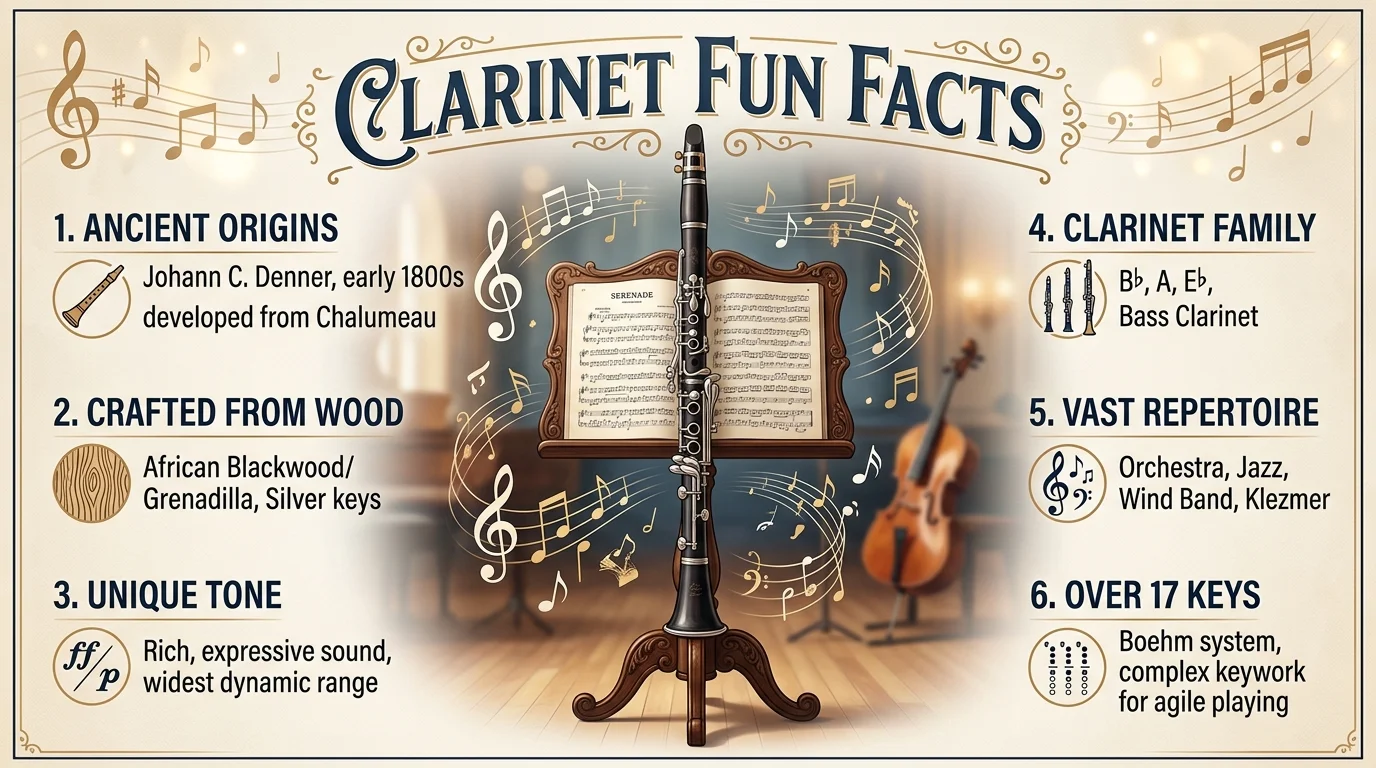
Clarinet fun facts reveal a versatile woodwind instrument invented in 1700 by Johann Christoph Denner. Evolving from the simple chalumeau, it features a unique cylindrical bore, five distinct playing registers, over 300 intricate parts, and a massive range spanning over three and a half octaves across classical and jazz genres.
When you think of the orchestra, the shiny brass or sweeping violins might steal the initial spotlight. Yet, these clarinet fun facts prove that this sleek woodwind holds the true secret power behind musical expression.
From jazz clubs to marching bands, the instrument bridges every musical gap imaginable. Understanding these clarinet fun facts will give you a fresh appreciation for its rich history and acoustic marvels.
Whether you play the instrument or just love a great tune, exploring clarinet fun facts is pure entertainment. Let’s explore what makes this marvelous woodwind so special.
The Humble Beginnings: How the Clarinet Came to Be
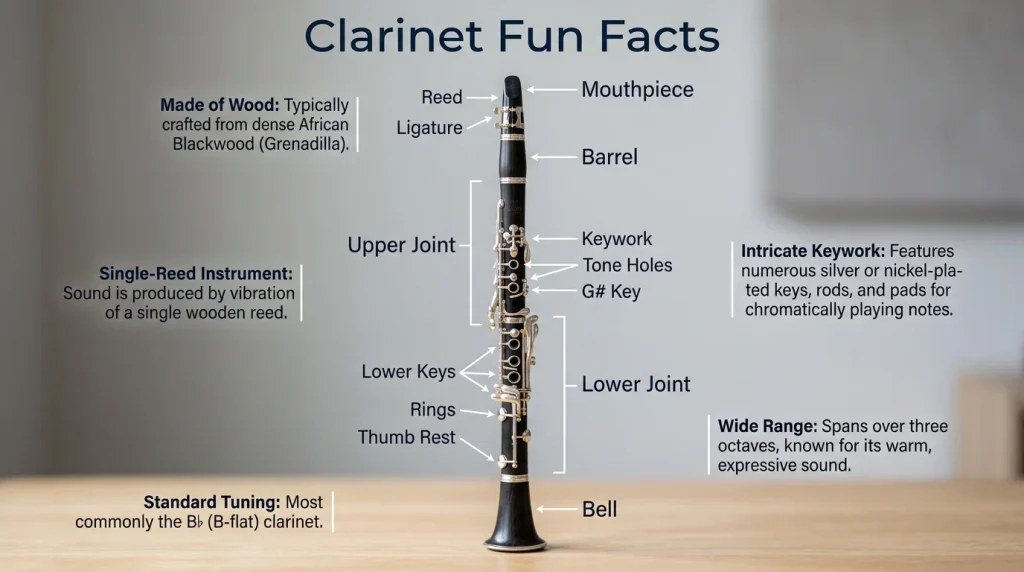
Every incredible invention has a backstory, and this woodwind is no exception. Its journey from a basic noise-maker to a refined musical masterpiece spans centuries of trial, error, and acoustic genius.
The Chalumeau Connection
Long before modern orchestras existed, folk musicians played a simple single-reed instrument called the chalumeau. It sounded somewhat like a recorder but used a single piece of cane tied to the mouthpiece.
While the chalumeau was great for rustic tunes, it had a very limited musical range. Players could barely squeeze out an octave, which made playing complex songs nearly impossible for musicians of that era.
Johann Christoph Denner’s Breakthrough
Around the year 1700, a brilliant German instrument maker named Johann Christoph Denner decided to fix the chalumeau’s limits. He added a revolutionary key near the thumb hole known as the register key.
This single modification allowed the instrument to jump up a full octave and a fifth in pitch. That clever tweak transformed a humble folk tool into the prototype of the modern clarinet we recognize today.
Where Does the Name Come From?
When people first heard Denner’s modified instrument in the upper register, it reminded them of a tiny trumpet. The Italian word for a small trumpet was clarinetto.
Over time, that name shifted into English as clarinet. It is a fitting name for an instrument that can sound like a sweet bird or a brassy trumpet depending on who plays it.
Acoustic Secrets and Unique Design Features
The way sound travels through wood and metal is pure science mixed with art. The physical shape of the instrument creates unique musical behaviors found nowhere else in the orchestra.
The Magic of the Cylindrical Bore
Most woodwind instruments, like the saxophone or oboe, are conical, meaning they get wider from top to bottom like a funnel. The clarinet is special because it uses a cylindrical bore that stays the same width down the body.
This straight tube design completely changes how sound waves travel inside. It forces the air column to vibrate in a way that skips even-numbered harmonics, creating its signature warm, hollow tone.
Jumping Thirds Instead of Octaves
Because of that straight inner shape, pressing the register key does not jump up an octave like a flute or saxophone does. Instead, it jumps an octave plus a fifth, which equals twelve full scale notes.
- Flute / Saxophone Register Jump: 1 Octave (8 Scale Steps)
- Oboe Register Jump: 1 Octave (8 Scale Steps)
- Clarinet Register Jump: 1 Octave + 5th (12 Scale Steps)
This mechanical quirk means fingerings for low notes do not match the fingerings for high notes. Clarinetists essentially have to learn two distinct fingering systems for one single instrument.
Why Is It a Transposing Instrument?
If you play a C on a standard Bb clarinet, the actual pitch that comes out in the room is a Bb. This happens because early makers built instruments in different fixed keys to play in different scales easily.
- Bb Clarinet: Plays a C, actual pitch heard is Bb (Most Common)
- A Clarinet: Plays a C, actual pitch heard is A (Orchestra Standard)
- Eb Clarinet: Plays a C, actual pitch heard is Eb (High-Pitched Squeaker)
- Bass Clarinet: Plays a C, actual pitch heard is Bb (One Octave Lower)
Instead of forcing players to learn brand-new fingering charts for every size, music was rewritten so the player uses the same fingerings on every horn. The sheet music does the transposing work for the player behind the scenes.
The Physical Anatomy of a Clarinet
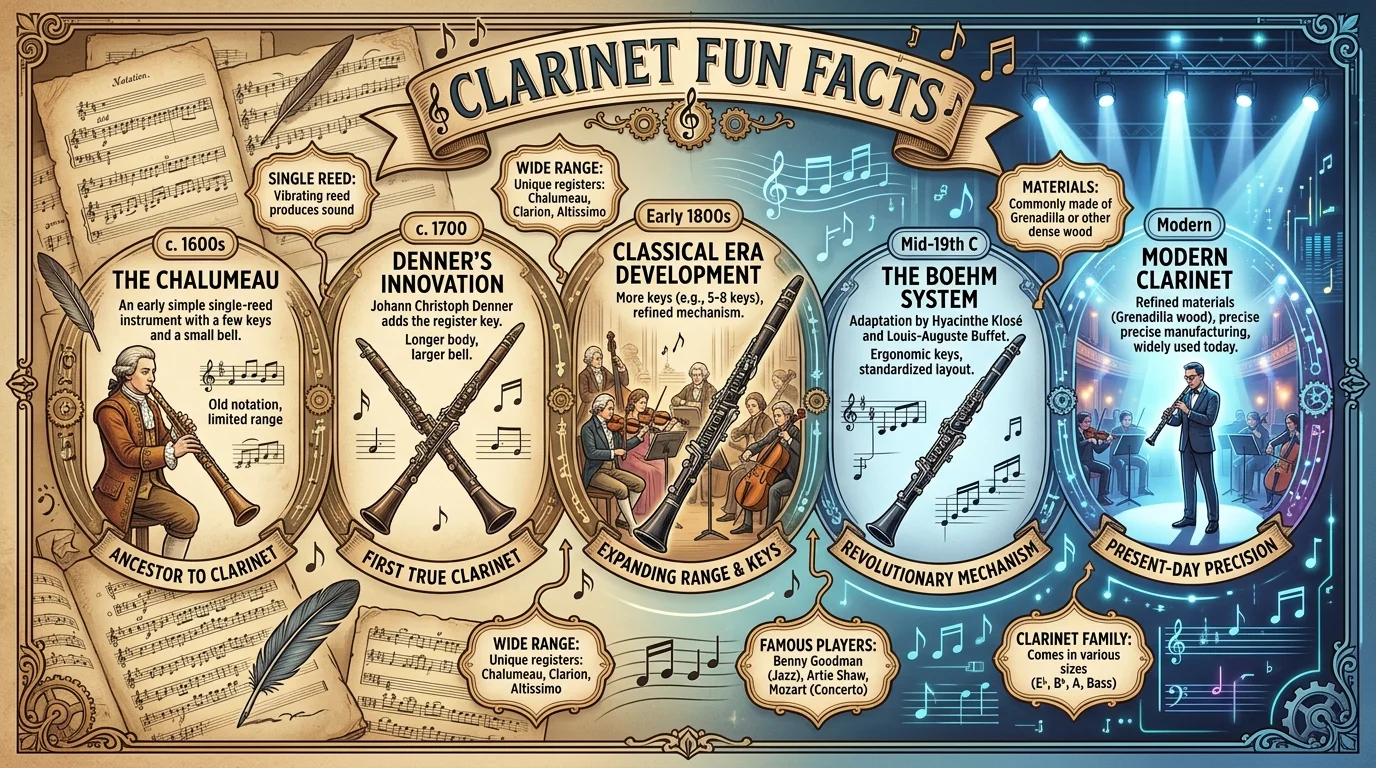
If you take apart a standard Bb model, you hold a collection of precision-engineered parts. Each piece serves a specific role in shaping air pressure, pitch, and timbre.
- Mouthpiece & Reed: Vibrates to create raw sound waves. Usually made of hard rubber, plastic, or natural cane.
- Barrel: Tunes the overall pitch of the instrument. Made from grenadilla wood or synthetic resin.
- Upper Joint: Houses the left-hand keys and register key. Built using dense African blackwood or ebonite.
- Lower Joint: Houses the right-hand keys and lower tone holes. Also built from African blackwood or ebonite.
- Bell: Projects low notes and rounds out the overall sound. Crafted from grenadilla wood or synthetic resin.
The African Blackwood Legend
High-end professional instruments are made from a very dense wood called Grenadilla, or African Blackwood. This wood grows extremely slowly in eastern Africa and takes years to season properly before turning on a lathe.
The wood is so heavy and dense that it actually sinks in water. Its extreme density gives the instrument its legendary dark, rich, and projection-heavy musical voice.
Over 300 Moving Parts
A modern key system on a Boehm system horn contains over 300 individual components working together. This includes small steel springs, tiny screws, felt bumpers, and soft leather or bladder pads.
If a single pad shrinks or a tiny screw loosens by half a turn, the instrument might leak air. That tiny air leak can make the entire horn stop playing notes correctly.
The Humble Cane Reed
The sound starts with a tiny piece of natural cane called Arundo donax. Farmers grow this giant grass in sunny regions like Southern France for years before harvesting and drying it carefully.
Musicians shave this grass down to fractions of a millimeter at the tip. That tiny piece of dried plant matter vibrates thousands of times per second to create every note you hear.
Registers of the Clarinet: A Tonal Spectrum
One reason composers love writing for this instrument is its incredible tonal range. It spans over three and a half octaves, broken down into distinct sonic personalities.
The Chalumeau Register
The lowest notes on the horn make up the Chalumeau register. It covers the deep range from low E up to the F inside the musical staff.
This range sounds dark, mysterious, rich, and slightly moody. Film composers love using these low notes to create tension or cozy bedtime atmospheres in movies.
The Throat Tones
Just above the chalumeau notes sit the awkward middle notes called throat tones. They use very little of the instrument’s tube length, so the sound vents early near the top joint.
These notes can sound thin or bright if the player does not support their airflow well. Mastering these tricky notes is a major rite of passage for every growing student.
The Clarion Register
Pressing the thumb register key opens up the Clarion register, stretching high above the staff. This range sounds bright, clear, singing, and beautifully expressive.
It is named clarion because it mirrors the triumphant singing tone of a trumpet. Most famous classical solos and sweeping melodies live right in this sweet spot.
The Altissimo Register
The highest region of the horn is called the Altissimo register. Reaching these soaring notes requires fast air streams, tight lip support, and complex combination fingerings.
In the right hands, these ultra-high notes sound thrilling and intense. In inexperienced hands, however, they can easily sound like a panicked tea kettle reaching full boil.
Surprising Clarinet Fun Facts That Will Amaze You

Now that you know how the instrument works, let’s explore some bizarre, hilarious, and fascinating trivia from its long history.
- Mozart Was Obsessed: Wolfgang Amadeus Mozart loved the instrument more than almost any other woodwind. He called its sound the closest thing to the human voice and wrote his famous Clarinet Concerto for his friend Anton Stadler.
- Squidward’s Mistake: The famous cartoon character Squidward Tentacles plays a clarinet, but his sound technique is terrible. He uses a terrible mouth position and rarely maintains his reed, which explains why his neighbors complain!
- The Famous Glissando: The iconic opening slide of George Gershwin’s Rhapsody in Blue was originally written as a joke during rehearsal. The player slid up all seventeen notes smoothly, and Gershwin loved it so much he kept it in the official score.
- Plastic vs. Wood: Student models are built from durable ABS plastic so they won’t crack in cold weather. Professional models use rare wood that can crack instantly if exposed to sudden temperature changes or high humidity.
- The Largest Clarinet Family: The family tree is huge, ranging from the tiny Eb clarinet down to the massive octocontrabass model. The octocontrabass is over 8 feet tall and plays notes so low that human ears feel the vibrations as pulses rather than clear pitches.
How to Care for a Woodwind Instrument

Taking care of a delicate woodwind requires daily discipline. Proper maintenance keeps the pads dry, prevents key corrosion, and stops real wood from cracking under pressure.
Swabbing After Every Use
Every time a player blows into the instrument, warmth and moisture build up inside the tube. If left sitting, this liquid damages internal pads and causes unpleasant mold growth.
Players drop a weighted silk or cotton swab through the bell and pull it through the top joint. Doing this after every single practice session extends the life of the instrument by years.
Protecting Wood From Temperature Shock
Real African Blackwood expands and contracts when temperatures shift rapidly. Bringing a cold wooden horn into a hot room and blowing warm breath inside can split the body wide open.
- Keep the instrument case away from drafty windows and radiators.
- Warm up the body with your hands before playing in cold spaces.
- Use small humidifiers inside the storage case during dry winter months.
Caring for the Single Reed
Reeds are natural items that warp easily when wet. Players must wipe off excess saliva after playing and store their reeds flat inside protective cases.
Rotating through a set of four or five reeds allows each reed to dry slowly and rest between uses. This smart habit helps your reeds last twice as long without losing their snappy musical response.
🎵 MCQs
1. What type of instrument is a clarinet?
A) String instrument
B) Woodwind instrument
C) Percussion instrument
D) Brass instrument
2. What material is traditionally used to make a clarinet mouthpiece reed?
A) Wood
B) Glass
C) Cane
D) Steel
3. How does a clarinet player produce sound?
A) By hitting the keys
B) By blowing air through a vibrating reed
C) By shaking the instrument
D) By rubbing the instrument
4. Which part of the clarinet helps create its sound?
A) Reed
B) Bow
C) Drumhead
D) Strings
5. What is the most common color of a traditional clarinet?
A) Black
B) Pink
C) Yellow
D) White
6. Where can clarinets commonly be found?
A) Orchestras and bands
B) Only rock concerts
C) Only churches
D) Only sports stadiums
7. Which family does the clarinet belong to?
A) Woodwind
B) Brass
C) String
D) Percussion
8. What do clarinet players use to change notes?
A) Keys
B) Strings
C) Drumsticks
D) Pedals
9. Which famous composer wrote music featuring the clarinet?
A) Mozart
B) Picasso
C) Shakespeare
D) Michelangelo
10. What is attached to the clarinet mouthpiece to help produce sound?
A) Reed
B) Bow
C) Bell
D) Drumstick
✅ Answer Key
- B
- C
- B
- A
- A
- A
- A
- A
- A
- A
FAQs
Why is the clarinet so hard to play at first?
The instrument feels tricky for beginners because covering the holes requires exact finger placement without air leaks. Additionally, learning to control the single reed with mouth pressure takes patience to avoid loud squeaks.
Is the clarinet part of the woodwind or brass family?
It belongs to the woodwind family because sound is produced by a vibrating wooden reed. Even though some keys and student models feature metal or plastic, its sound mechanism defines it as a woodwind.
How often should you change a clarinet reed?
A standard reed lasts between two to four weeks depending on practice time and proper care. Rotating multiple reeds extends their lifespan, while chipped or warped reeds should be replaced immediately.
What is the difference between an Eb and Bb clarinet?
The Bb model is standard size and yields a rich, warm tone for general band playing. The Eb model is much smaller, higher in pitch, and delivers a piercing, bright sound used for orchestra highlights.
Can adults learn to play the clarinet easily?
Yes, adults can pick up the instrument quickly because reading music and understanding breath support comes naturally with age. Simple motor skills transfer easily, making it a rewarding hobby at any stage of life.
Why does my clarinet squeak when I play?
Squeaking usually happens when your fingers do not cover tone holes completely, leaving tiny air gaps. It can also stem from taking too much mouthpiece into your mouth or using a cracked reed.
Conclusion
Exploring these clarinet fun facts shows why this versatile woodwind remains an absolute powerhouse across musical history. Its journey from a basic folk chalumeau to a masterwork of engineering highlights centuries of passion and scientific design.
From its signature cylindrical bore to its incredible tonal range, the horn offers something special for every listener and performer. Few instruments can jump from classical symphonies to soulful jazz riffs with such ease and charm.
Whether you are starting your musical journey or simply love listening, keeping these clarinet fun facts in mind brings whole new layers of enjoyment. Pick up an instrument, try a lesson, or drop on a classic record today to experience this acoustic marvel firsthand!

Ethan Danial is the creator and lead writer behind FunWhirls.com, a fun-focused platform dedicated to entertaining ideas, fascinating facts, funny moments, creative lists, and content that sparks curiosity. With a genuine love for discovering interesting and unexpected topics, Ethan enjoys turning simple ideas into engaging content that readers can enjoy, learn from, and share. His approach is centered on making every article easy to read, enjoyable, and worth coming back to.
At FunWhirls.com, Ethan Danial explores the lighter and more entertaining side of everyday life. He creates content for readers who love discovering something new, having a quick laugh, or simply taking a break from the ordinary. From curious facts to playful ideas and entertaining discoveries, Ethan aims to keep the content fresh, positive, useful, and engaging for readers of all kinds.