Avocado fun facts reveal that this beloved food is actually a single-seeded giant berry, not a vegetable. Originating in Central America over 10,000 years ago, avocados rely on unique pollination traits, contain more potassium than bananas, and were once saved from extinction by ancient megafauna like giant ground sloths.
Have you ever wondered why your morning toast topic is actually one of the strangest items in the produce aisle? Exploring avocado fun facts shows that this creamy staple is full of botanical quirks, historical mysteries, and bizarre survival stories.
Most people treat them like veggies, but these green delights have a wild personality all their own. Learning these avocado fun facts will completely change how you view your favorite guacamole ingredient.
Get ready to impress your friends during your next brunch outing with these surprising truths. Let’s look at what makes this weird green fruit so special.
The Botanical Secrets of the Avocado

When you pick up an avocado at the grocery store, you are holding a true botanical marvel. Most people lump them in with vegetables because of their savory flavor and green color. However, plant scientists view them in a completely different light.
Understanding the nature of this plant helps explain why it behaves so differently from other fruits. It all starts with how the plant builds itself from the inside out.
Is It a Fruit, a Veggie, or Something Else?
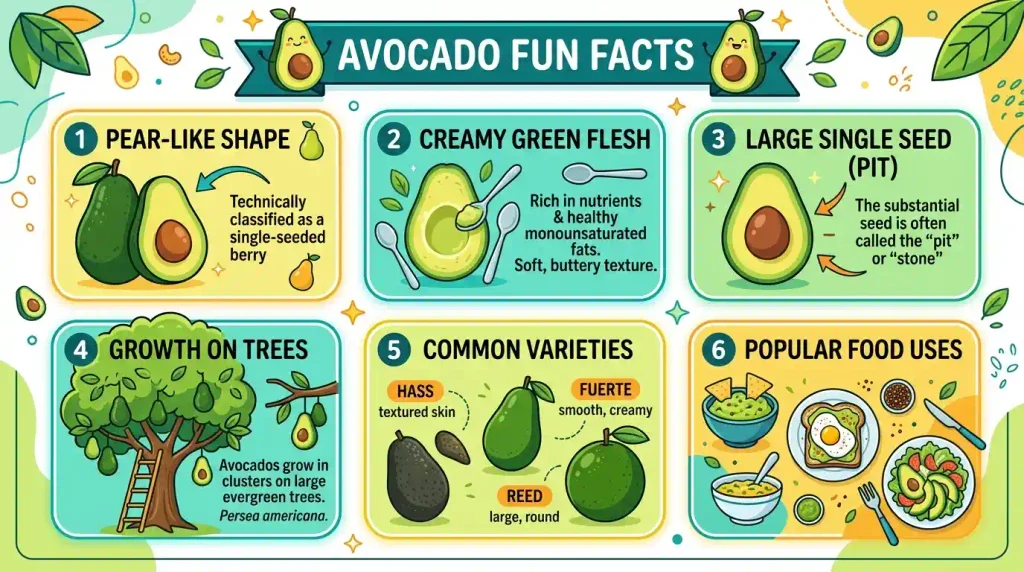
Botanically speaking, the avocado is a fruit. To be even more specific, it is a single-seeded berry.
A berry is defined as a fleshy fruit produced from a single ovary without a hard layer inside. The large pit in the middle is actually the seed’s protective jacket. That means when you make guacamole, you are technically making a cold fruit soup.
Why They Are Classified as Giant Berries
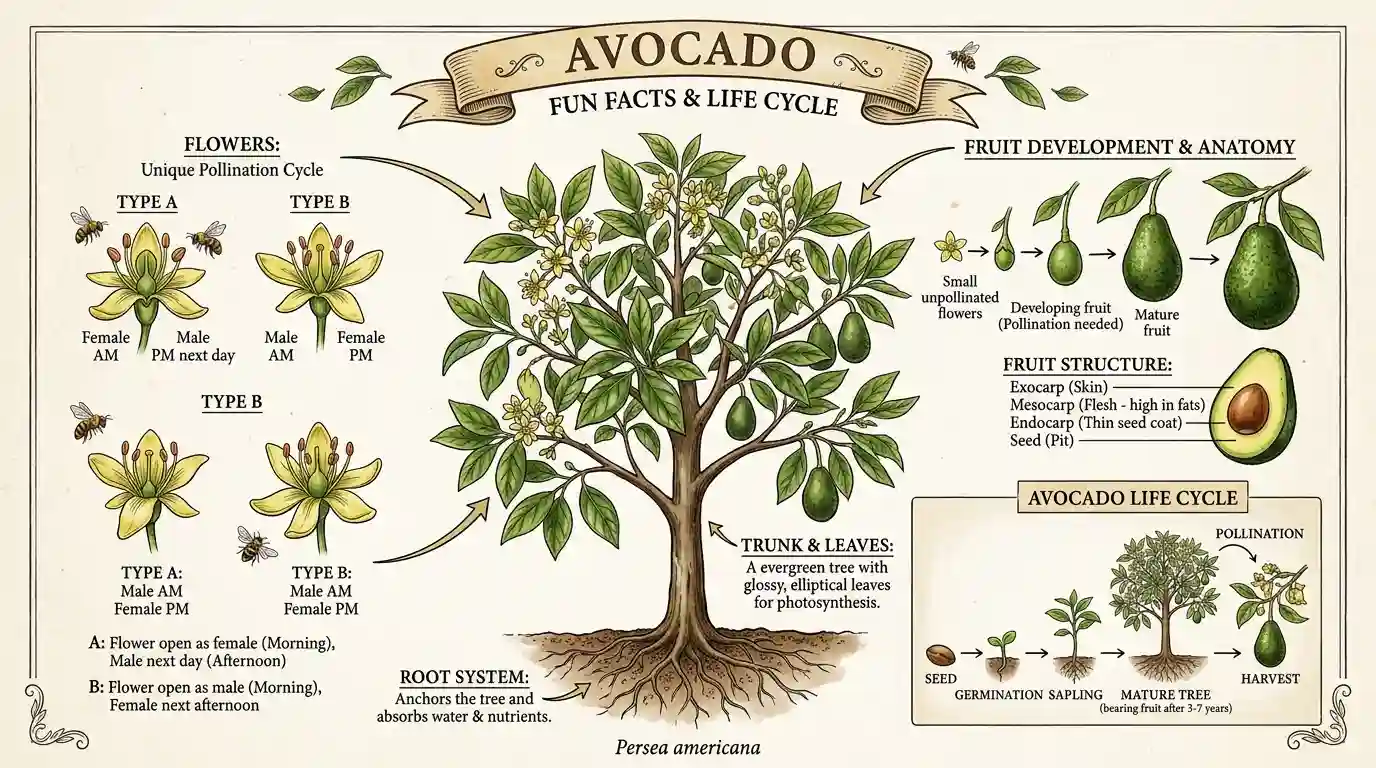
To qualify as a berry, a fruit must have three distinct layers. The outer skin is the exocarp, the fleshy middle is the mesocarp, and the inner layer surrounding the seed is the endocarp.
In avocados, the endocarp is extremely thin and soft, wrapping right around the seed. Because the fleshy middle stays soft and edible, it fits the strict definition of a berry perfectly. It just happens to be one of the largest berries on Earth.
The Mystery of the Single Large Seed
Most berries, like blueberries or tomatoes, carry dozens of tiny seeds scattered throughout their flesh. The avocado took an entirely different evolutionary route by placing all its bets on one massive seed.
This oversized pit stores a huge amount of energy for the sprouting seedling. It allows a young tree to grow tall quickly, even under a dense forest canopy where sunlight is scarce.
Ancient History and the Evolutionary Gamble

The story of how this fruit survived to modern times sounds like a wild sci-fi novel. Millions of years ago, the planet looked very different, and so did the creatures eating from the forest trees.
Without a few lucky turns of history, we would not have guacamole today. The plant made a dangerous evolutionary bet that almost led to its total extinction.
Saved by Prehistoric Megafauna
During the Cenozoic era, massive mammals roamed North and South America. Giant ground sloths, called Megatherium, grew as big as modern elephants. Gomphotheres, which were ancient relatives of elephants, also wandered these forests.
These massive animals ate whole avocados, seed and all. They digested the fleshy pulp and passed the hard pit intact as they traveled miles away. This was the only way the tree could spread its seeds across the landscape.
What Happened When the Giants Died Out?
About 10,000 years ago, most of these giant mammals went extinct at the end of the Ice Age. Smaller animals like squirrels and birds could not swallow the massive pit.
This created an evolutionary bottleneck. The trees were stuck dropping their heavy fruit right beneath their own branches, where young saplings could not get enough light to survive. The species began to shrink in population and faced total disappearance.
How Humans Stepped in to Save the Day
Luckily for the avocado, early human civilizations in Central America stepped in just in time. Indigenous groups discovered that the fruit was rich, nutritious, and easy to cultivate.
They began planting the seeds around their settlements, selecting the trees with the thickest, creamiest flesh. Humans effectively replaced the extinct giant sloths as the primary distributors of the plant.
How Avocado Trees Perform Their Weird Mating Dance
If you think the history is strange, wait until you look at how these trees reproduce. Avocado trees do not pollinate themselves like standard fruit trees.
Instead, they use a bizarre timing system that scientists call synchronous dichogamy. This behavior requires two distinct groups of trees working in perfect harmony.
Type A vs. Type B Flowering Cycles
Every tree falls into one of two categories: Type A or Type B. The flowers on these trees contain both male and female organs, but they open them at completely different times of the day.
- Type A flowers open as female in the morning, close at midday, and reopen as male the following afternoon.
- Type B flowers open as female in the afternoon, close for the night, and reopen as male the next morning.
This clever scheduling trick prevents the tree from fertilizing itself, which keeps the gene pool diverse and strong.
The Role of Bees and Wind in Pollination
Because the male and female phases happen at opposite times, Type A and Type B trees must grow near each other. Warm temperatures cause the flowers to open precisely on schedule.
Honeybees and native insects carry pollen from a male-phase flower on a Type B tree to a female-phase flower on a Type A tree. Without insects traveling between the two types during those short overlapping windows, no fruit will grow.
Why Growing from Seed Is Always a Gamble
If you plant a pit from a delicious avocado you bought at the store, you will not get the same fruit. Because the tree relies on cross-pollination between two different parents, every seed produces a genetic wild card.
A tree grown from seed might take 10 to 15 years to produce fruit. Worse yet, the fruit it produces might be tiny, stringy, or completely unpalatable.
The Hass Revolution and the Tree That Started It All
Almost every avocado sold in grocery stores today belongs to a single variety called the Hass. The story behind this popular variety is a classic tale of accidental discovery and fortunate persistence.
It transformed a niche regional crop into an international phenomenon.
Rudolph Hass and His Accidental Discovery
In the late 1920s, a mail carrier named Rudolph Hass bought a few avocado seeds to plant in his California backyard. He wanted to grow strong rootstock so he could graft popular varieties onto them.
One seed grew into a stubborn young tree that refused to accept any grafts. Hass almost chopped the tree down, but his children loved the rich taste of its weird, bumpy fruit.
Why the Hass Variety Conquered the Market
Unlike older varieties that had smooth green skins, the fruit from this tree turned dark purple-black when ripe. Its thick, pebbly skin protected the soft flesh during shipping, preventing bruises.
The flesh was also much higher in oil, giving it a rich, nutty flavor that consumers preferred. In 1935, Rudolph Hass patented the variety, marking the first patent ever issued for an avocado tree.
The Mother Tree in La Habra, California
Every single Hass tree alive today is a clone of that original tree growing in La Habra, California. Farmers propagated new trees by taking cuttings from the original mother tree and grafting them onto rootstock.
The original Mother Tree survived for decades before dying of root rot in 2002. A plaque now stands in its place to honor its contribution to world agriculture.
Surprising Health and Nutrition Insights
Beyond their wild history and botanical quirks, these fruits pack a serious punch when it comes to human health. They break almost all the standard rules for fruit nutrition.
While most fruits are high in natural sugars and carbohydrates, this green berry is loaded with healthy fats and essential minerals.
Packed with Healthy Fats
The most famous trait of this fruit is its high fat content. Roughly 70 to 80 percent of its calories come from fat, mostly in the form of oleic acid.
Oleic acid is a monounsaturated fat that supports heart health and helps reduce inflammation. It is the same beneficial fat found in high-grade olive oil.
The Potassium Powerhouse That Beats Bananas
When people think of potassium, they usually reach for a banana. However, avocados actually contain significantly more potassium than bananas, weight for weight.
A medium fruit provides about 15 percent of your daily recommended potassium, compared to just 10 percent from a standard banana. Potassium helps regulate blood pressure and keeps your muscles functioning smoothly.
Boosting Nutrient Absorption in Other Foods
Eating fats alongside vegetables does something magical for your body. Many vital nutrients, such as Vitamins A, D, E, and K, are fat-soluble, meaning your body needs fat to absorb them properly.
Adding a few slices to a fresh garden salad helps your body absorb up to 15 times more antioxidants from the leafy greens.
Comparison of Popular Avocado Varieties
While the dark, pebbly Hass dominates store shelves worldwide, it is just one member of a massive family containing hundreds of distinct avocado varieties. Different varieties vary wildly in skin texture, oil content, cold hardiness, and harvest schedules. Exploring these differences helps you select the perfect fruit for your kitchen, whether you want a rich, buttery mash for guacamole or a firm, low-fat slice for a summer salad.
Hass: The Undisputed King of Commercial Production
The Hass variety accounts for roughly 80% of all avocados consumed across the globe today. Its distinctive thick, pebbly skin changes from green to a deep purplish-black when ripe, offering a built-in visual cue for consumers. Thanks to its exceptionally high oil content—around 20% or more—the Hass delivers a rich, creamy, and distinctly nutty flavor profile. Its thick skin also acts as natural armor during long-distance shipping, making it the most durable and reliable variety for international trade.
Fuerte: The Classic Smooth-Skin Green-Skin Pioneer
Before the Hass gained commercial dominance, the Fuerte was the standard choice for avocado lovers worldwide. Originating in Puebla, Mexico, “Fuerte” means “strong” in Spanish, named for the variety’s ability to survive severe California frosts in the early 1900s. It features a thin, smooth, bright green skin that stays green even when fully ripe. The Fuerte offers a medium oil content, giving it a lighter, fresh, and slightly grassy flavor that makes it ideal for slicing into sandwiches or fresh garden salads.
Reed and Choquette: The Giant Backyard Favorites
For those who want maximum yields, giant varieties like Reed and Choquette deliver impressive size without sacrificing taste. The Reed is a round, baseball-sized fruit with a thick green skin and an intensely buttery flavor that stays firm when sliced. The Choquette, a popular Florida variety, can weigh up to two pounds per fruit. Because water-based varieties like Choquette have a lower oil and higher water content, they offer a milder, lighter taste and release high amounts of natural juice when cut.
Odd Uses and Cultural Quirks Around the World

Different cultures around the globe interact with this fruit in wildly different ways. In North America, it is almost exclusively treated as a savory dish served with salt, garlic, and lime.
However, if you travel across Asia or South America, you will find people enjoying it as a sweet treat instead.
Sweet Delights in Brazil and Southeast Asia
In Brazil, people rarely add salt to their avocados. Instead, they blend the fruit with milk, sugar, and lime juice to make a refreshing drink called vitamina de abacate.
In Vietnam and the Philippines, street vendors blend the rich pulp with condensed milk and poured ice to create creamy dessert smoothies.
The Ink of Ancient Aztecs
Long before modern dye factories existed, indigenous cultures in Central America used the inner seed to make permanent ink. When you crush the pit, it releases a milky liquid that turns reddish-brown when exposed to air and light.
Conquistadors used this natural ink to write official documents and maps, many of which survive in historical archives today.
Skincare and Cosmetic Secrets
The rich oils in the flesh are not just good for eating. Cosmetic companies extract the oil to use in high-end moisturizing creams, soaps, and hair masks.
The high concentration of fatty acids and vitamin E helps soothe dry skin and repair damaged hair follicles naturally.
Kitchen Hacks and Everyday Tricks
Dealing with this fruit in the kitchen can sometimes feel frustrating. One day it is hard as a rock, and the next day it seems overripe and brown.
Knowing a few simple kitchen tricks helps you get the absolute best out of every fruit you purchase.
How to Ripen an Avocado in 24 Hours
If you buy a rock-hard fruit for dinner tomorrow, you can speed up its natural ripening process using basic plant science. Place the green fruit inside a brown paper bag along with an apple or a banana.
Apples and bananas release high amounts of ethylene gas, a natural plant hormone that triggers ripening. The paper bag traps the gas inside, turning your hard fruit soft and tender in a day or two.
Preventing That Frustrating Brown Oxidation
When you cut an avocado open, an enzyme called polyphenol oxidase reacts with oxygen in the air. This chemical reaction turns the green flesh brown, much like a cut apple.
To slow this process down, coat the exposed flesh with an acidic juice like lime or lemon. The acid lowers the pH level, disabling the enzyme and keeping the flesh bright green for much longer.
The Best Way to Peel for Maximum Nutrition
Most people scoop the green flesh out with a spoon, leaving behind the dark green layer right next to the skin. That dark outer layer actually contains the highest concentration of beneficial antioxidants.
To keep that nutrient-rich layer, cut the fruit into quarters lengthwise, remove the pit, and peel the skin back like a banana peel.
MCQs
- What is the large seed inside an avocado commonly called?
A) Pit
B) Shell
C) Root
D) Stem - What color is the flesh of a ripe avocado usually?
A) Green
B) Blue
C) Purple
D) Orange - Where do avocados grow?
A) On trees
B) Underground
C) On vines
D) In bushes - Which part of an avocado is usually eaten?
A) Flesh
B) Pit
C) Stem
D) Leaves - What is a popular food made from mashed avocado?
A) Guacamole
B) Pancakes
C) Popcorn
D) Noodles - What type of fruit is an avocado botanically?
A) Berry
B) Citrus
C) Stone fruit
D) Nut - Which nutrient is naturally abundant in avocados?
A) Healthy fats
B) Caffeine
C) Sodium
D) Sugar - What is the outer covering of an avocado called?
A) Skin
B) Shell
C) Bark
D) Husk - What happens to many avocados as they ripen?
A) They become softer
B) They become harder
C) They lose their seed
D) They turn into flowers - Which meal commonly includes sliced avocado?
A) Avocado toast
B) Ice cream sundae
C) Cotton candy
D) Popcorn
Answer Key
- A
- A
- A
- A
- A
- A
- A
- A
- A
- A
FAQs
Can dogs safely eat avocados?
No, dogs should not eat them in large quantities. The plant contains a toxin called persin, which can cause mild to severe stomach upset in dogs. The large pit also poses a dangerous choking and intestinal blockage hazard for pets.
Why do some avocados have dark stringy fibers inside?
Dark, stringy fibers inside the flesh usually come from poor growing conditions or improper storage. Young trees often produce fibrous fruit, and exposure to extreme cold during transportation can cause the vascular bundles inside the flesh to darken.
How can you tell if an avocado is perfectly ripe?
You can test for ripeness by gently squeezing the fruit in the palm of your hand. A ripe fruit will yield slightly to gentle pressure without feeling mushy. Another great indicator is whether the small stem cap peels away easily to reveal green underneath.
Can you freeze whole or mashed avocados?
Yes, you can freeze them for long-term storage. Mash the flesh with a small splash of lemon or lime juice to prevent browning, then seal it tightly in an airtight freezer bag. Frozen pulp works great in smoothies or cooked dishes after thawing.
Why is the avocado called an alligator pear in some places?
People historically called it an alligator pear due to its physical appearance. The rough, pebbly skin of green varieties resembles the skin of an alligator, while the overall shape of the fruit looks very similar to a standard European pear.
How long does an avocado tree take to produce fruit?
Grafted trees purchased from nurseries usually start bearing fruit within three to four years. However, if you grow a tree directly from an avocado seed, it can take anywhere from seven to fifteen years to produce its very first harvest.
Conclusion
Exploring these avocado fun facts shows that this creamy staple is far more than just a trend. From its heroic survival alongside prehistoric giants to its bizarre flowering cycles, this unique berry has earned its place in human history.
Whether you enjoy them sliced on toast, blended into a sweet smoothie, or mashed into fresh guacamole, you can now appreciate the fascinating science behind every single bite. The humble alligator pear truly stands out as one of nature’s most impressive creations.
Next time you visit the grocery store, share these fun insights with someone standing in the produce aisle. Grab a few green berries, pop one in a paper bag with an apple, and enjoy the delicious results!

Ethan Danial is the creator and lead writer behind FunWhirls.com, a fun-focused platform dedicated to entertaining ideas, fascinating facts, funny moments, creative lists, and content that sparks curiosity. With a genuine love for discovering interesting and unexpected topics, Ethan enjoys turning simple ideas into engaging content that readers can enjoy, learn from, and share. His approach is centered on making every article easy to read, enjoyable, and worth coming back to.
At FunWhirls.com, Ethan Danial explores the lighter and more entertaining side of everyday life. He creates content for readers who love discovering something new, having a quick laugh, or simply taking a break from the ordinary. From curious facts to playful ideas and entertaining discoveries, Ethan aims to keep the content fresh, positive, useful, and engaging for readers of all kinds.