Birthday fun facts showcase how celebrations evolved from ancient pagan rituals into today’s cake-and-candle festivities. From the rarest calendar birthdates to royal tradition secrets, these captivating trivia nuggets explain why we sing special songs, blow out flickering flames, and share delicious sweet treats with loved ones around the globe every single year.
Ever wonder why we blow out lit candles on cakes or sing the same song at every party? These bizarre tradition origins show that our modern celebrations are actually packed with ancient history and quirky secrets. Exploring these birthday fun facts will change how you look at your special day forever!
Every year, millions of people gather around frosting-covered desserts to make silent wishes before taking a massive breath. Learning about birthday fun facts makes sharing cake with family and friends even more delightful. Let’s explore the unbelievable history, strange global customs, and fascinating science behind our annual personal milestones.
The Secret History Behind Birthday Celebrations

Long before modern paper hats and colourful party balloons, marking a person’s birth date was actually considered a dangerous event. Ancient cultures believed that major life transitions invited mischievous spirits to disrupt a person’s life. Gathering loved ones together with loud cheers was created as a protective ring of safety.
How Ancient Romans Created the First Birthdays
Ancient Romans were actually the very first civilization to celebrate birthdays for common, everyday citizens. Before their era, only powerful kings, queens, and gods received special annual celebration ceremonies.
Roman citizens organized grand banquets, shared wine, and offered prayers to keep spirits bright during festivities. However, these early celebrations were strictly reserved for men, while women had to wait several more centuries to get their own special recognition days.
Why Ancient Greeks Put Candles on Cakes
Ancient Greeks brought glowing candles and baked goods together in a truly magical ritual long ago. They baked round honey cakes to represent the glowing moon, placing lit candles on top to honor Artemis, the goddess of the moon.
The soft rising smoke carried heartfelt wishes up toward the sky directly to heavenly deities. Today, whenever you blow out glowing lights on frosting, you are repeating an ancient Greek spiritual ritual designed to send personal hopes into the sky.
Fascinating Facts About Birthday Songs and Music
Music has always been an essential ingredient of any proper milestone party across the world. Yet, the famous melody we all sing together started out as a simple classroom greeting for young children.
The True Origins of the Happy Birthday Song
In 1893, two Kentucky schoolteachers named Patty and Mildred Hill composed a sweet, simple classroom tune called “Good Morning to All.” Children quickly learned the easy rhythm, and people began swapping out the words during evening family gatherings.
Eventually, the catchy lyrics shifted into the famous birthday anthem we all know by heart today. It grew so popular that it eventually became one of the highest-earning song copyrights in human history!
The World Record for the Most Famous Tune
The standard melody for celebrating birthdays is officially recognized by Guinness World Records as the most recognized song in the English language. It has been translated into dozens of global languages, carrying the same joyous message everywhere.
Astronauts even sang this familiar song in outer space to honor fellow crew members orbiting far above Earth. No other musical arrangement brings people together so quickly across different cultures and age groups.
The World’s Rarest and Most Common Birthdays
Have you ever wondered how many other people share your exact calendar celebration day? Human birth records reveal incredible patterns showing that certain days of the year experience massive population surges.
September Is the Ultimate Birthday Month
Statistical data from birth certificates show that September contains the most common birthdates across the entire Northern Hemisphere. In fact, mid-September dates like September 9th and September 19th frequently top national charts.
- Holiday Season Planning: Conception rates peak during the chilly winter holiday season months.
- Fall Party Popularity: September parties enjoy cozy autumn weather, making outdoor gatherings wonderful.
- School Classmate Connections: Autumn babies often start school right around their big celebration day.
The Absolute Rarest Day to Be Born
Leap Day, which falls on February 29th, is statistically the rarest birthdate anyone can have. Because this unique calendar day appears only once every four years, people born on it are affectionately nicknamed “leaplings.”
Other exceptionally rare days include major national holidays like Christmas Day and New Year’s Day. Hospitals typically schedule fewer non-emergency procedures on major festive holidays, causing a noticeable dip in daily birth statistics.
Bizarre Birthday Traditions Around the Globe

Different cultures have developed wildly unique and entertaining ways to honour aging family members and friends. While some blow out candles, others pull ears, throw flour, or pull long noodles from hot soup bowls.
Pulling Earlobes and Flour Dusting
In several South American and European nations, friends pull the birthday person’s earlobes gently for every year lived. This funny custom is believed to encourage long life, as large earlobes traditionally symbolize wisdom and longevity.
In Jamaica, unsuspecting friends chase down the guest of honor to shower them with white flour. This playful “flouring” tradition turns aging into a chaotic, laughter-filled mess that brings total joy to party attendees.
Longevity Noodles and Golden Keys
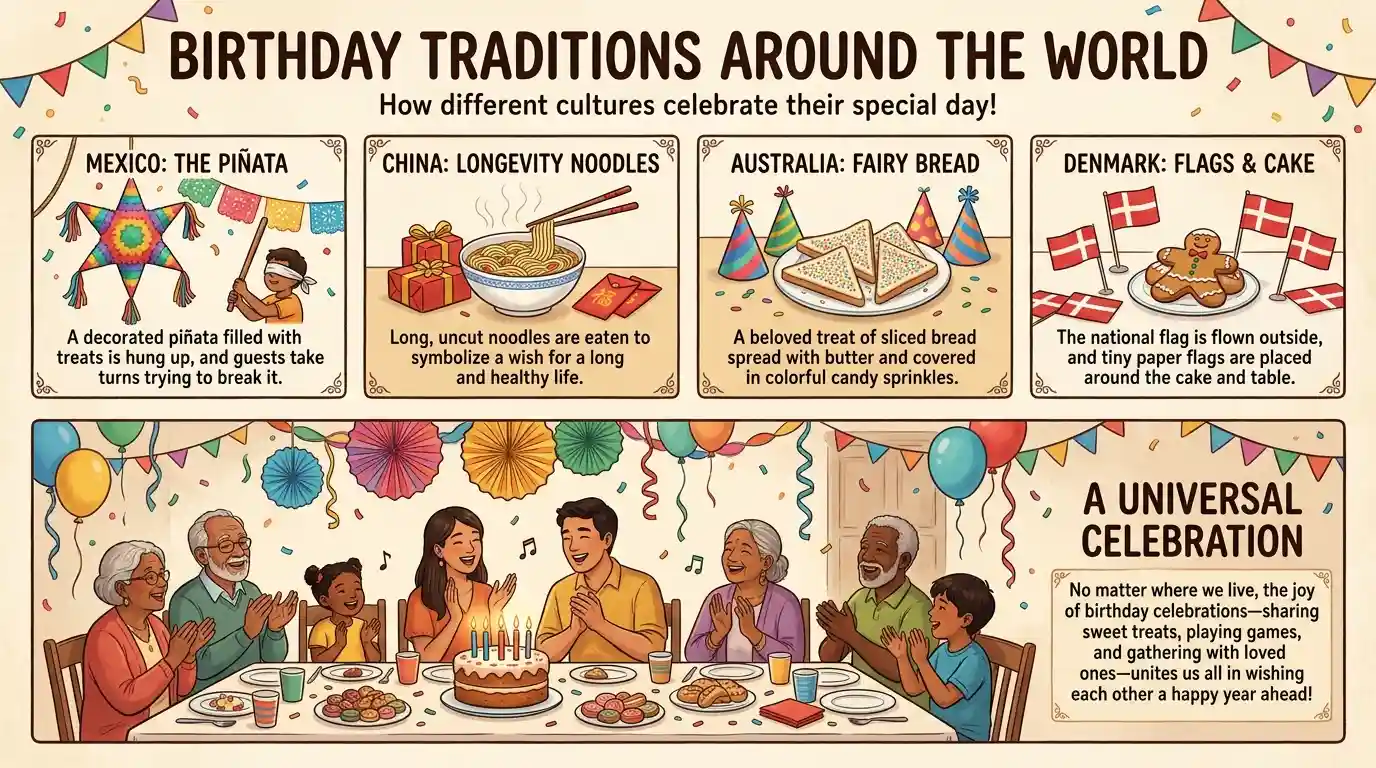
In China, eating a bowl of “longevity noodles” is a vital culinary ritual for personal celebrations. These continuous, uncut wheat noodles represent a long, smooth life, so slurping them up without breaking them brings incredible good luck.
Meanwhile, in Great Britain and Australia, turning twenty-one is traditionally celebrated with a symbolic golden key. This tradition symbolizes the young adult receiving the key to the family house, marking full independence and adult responsibility.
Why Piñata Sweets Rule Celebrations
Mexican celebrations feature colorful papier-mâché figures filled with delicious treats, fruit, and small toys. Blindfolded guests take turns swinging a wooden stick while crowd members sing encouraging rhythmic songs. Breaking the container symbolizes overcoming personal obstacles and receiving sweet blessings for the upcoming year ahead.
Royalty and Historic Birthday Oddities
Monarchs and historical figures have long enjoyed extravagant celebrations that set incredible precedents for modern society. Some kings even established official government rules to ensure their party weather remained completely bright and pleasant.
Why Kings Celebrate Birthdays Twice
King George II of Great Britain started an incredible royal tradition back in the year 1748 that continues today. Born in chilly November, the king grew tired of icy rain ruining his official public parade celebrations.
He decided to combine his official public party with the annual summer military parade called Trooping the Colour. As a result, British monarchs have enjoyed two distinct celebration days every year ever since!
Famous Historical Gifts and Giant Sweets
Throughout history, world leaders have exchanged jaw-dropping gifts to celebrate personal life milestones with maximum drama. These extravagant presents often involved legendary artistic creations that captivated the world.
- The Statue of Liberty: France presented this massive copper monument to the United States as a spectacular centennial gift.
- Fabergé Eggs: Russian Emperors commissioned intricate jeweled eggs filled with hidden golden treasures for royal family members.
- Giant Cheese Wheels: Queen Victoria received a massive half-ton wheel of cheddar cheese as a unique wedding and milestone present.
The Mind-Boggling Birthday Paradox

Mathematics contains a mind-bending probability trick that surprises almost everyone who hears it for the first time. It proves that human intuition often fails when calculating shared personal milestones within groups.
How Big Must a Group Be?
You might assume you need hundreds of people in a room to find two individuals who share the same month and day. However, mathematical probability proves you only need a surprisingly small group to reach a fifty percent chance of a match!
In a room containing just 23 people, there is already a 50% chance that two individuals share a birthdate. If you increase that group size to 75 people, the probability skyrockets to an astonishing 99.9%!
Why Your Mind Gets Tricked
Our brains naturally imagine matching our own specific birthdate against everyone else in the crowded room. But the math actually compares every possible pair of people in the space against each other simultaneously.
With 23 individuals, there are actually 253 different paired combinations interacting together at once! This exponential explosion of potential matches makes shared birthdates far more common than our everyday intuition expects.
Science and Psychology Behind Growing Older

Celebrating another trip around the glowing sun triggers powerful psychological and physical changes inside our bodies and minds. Scientists have spent decades researching how marking personal time impacts human happiness, memory formation, and social bonding.
The Psychology of Fresh Starts
Psychologists refer to personal milestone dates as “temporal landmarks” that reset our internal mental clocks completely. Crossing into a new year of life creates a powerful psychological effect known as the “fresh start effect.”
It allows our brains to leave past mistakes behind and establish clear, positive goals for the future ahead. This natural mental reset makes personal milestones the perfect time for creating lasting personal habits and positive mindset shifts.
Why Time Seems to Speed Up
Have you ever noticed that years seem to pass by much faster as you grow older? Neuroscientists explain that our brains measure time by processing new visual information, rich experiences, and novel memories.
When we are young, almost everything we encounter is brand new, making our internal processing slow down and memories feel vast. As adults establish routines, familiar days blur together, making annual celebrations arrive quicker every single year.
Practice Exercises
Q1. Which ancient civilization was the first to celebrate birth dates for ordinary citizens? A. Ancient Egyptians
B. Ancient Romans
C. Ancient Greeks
D. Ancient Mayans
Q2. Why did ancient Greeks put lit candles on top of round cakes? A. To scare away wild forest animals
B. To light up dark outdoor party tables
C. To honor Artemis, the goddess of the moon
D. To keep the sweet honey frosting warm
Q3. What was the original title of the famous melody used for the Happy Birthday song? A. Good Morning to All
B. Happy Day to You
C. Welcome Classmate Dear
D. Sunshine in the Morning
Q4. What is statistically the rarest standard birthdate in the calendar year? A. July 4th
B. October 31st
C. February 29th
D. December 31st
Q5. Why did King George II establish a second official celebration during the summer? A. He disliked sharing his winter party with holiday events
B. He wanted better weather for public outdoor military parades
C. His royal advisors forgot his actual birth date
D. Parliament forced him to celebrate twice by official law
Q6. In traditional Chinese culture, what does eating unbroken longevity noodles represent? A. Continuous good fortune in financial wealth
B. A long, smooth, and healthy life
C. Guaranteed success in educational examinations
D. Strong family unity during hard times
Q7. How many people need to be in a room for a 50% chance that two share a birthdate? A. 182 people
B. 100 people
C. 50 people
D. 23 people
Q8. What fun party tradition takes place during Jamaican celebrations? A. Throwing white flour over the guest of honor
B. Pulling earlobes for every year lived
C. Eating unbroken hot noodles in one bite
D. Receiving a symbolic decorative golden house key
Q9. What do psychologists call the mental motivation triggered by major milestone dates? A. The temporal memory shift
B. The psychological reset button
C. The fresh start effect
D. The annual motivation surge
Q10. Which month contains the highest number of common birthdates in the Northern Hemisphere? A. January
B. June
C. September
D. November
Answer Key
B
C
A
C
B
B
D
A
C
C
FAQs
Why do we make a wish before blowing out cake candles?
The custom comes from ancient beliefs that fire smoke carried prayers directly to sky deities. Today, making a silent wish before extinguishing flickering flames remains a cherished modern tradition believed to bring wonderful good fortune for the upcoming year ahead.
What is the most common birthday month in the world?
September is statistically the most common birth month across the Northern Hemisphere. This pattern occurs because human conception rates peak globally during the cozy, festive winter holiday season roughly nine months prior to late autumn.
Why do people get bumped or ear-pulled on celebrations?
These physical birthday traditions stem from ancient beliefs about physical growth and long life. Pulling earlobes or giving friendly “bumps” symbolically encourages the celebrated individual to grow taller, gain wisdom, and live a long, prosperous life.
Who owns the copyright to the Happy Birthday tune today?
The famous melody is currently in the public domain worldwide after lengthy legal court battles. Today, anyone can freely sing, perform, film, or record the iconic song commercially without paying costly royalty licensing fees.
Is February 29th the absolute rarest date to be born?
Yes, February 29th is the rarest calendar date because it occurs only during leap years every four years. People born on this unique day typically celebrate their personal milestones on February 28th or March 1st during standard non-leap years.
Why do we bake sweet cakes for milestone celebrations?
Round cakes originated in ancient civilizations as symbolic offerings to gods, made from rare sweet ingredients like honey, nuts, and dried fruit. Over time, affordable sugar made sweet desserts accessible for ordinary family celebrations everywhere.
Conclusion
Uncovering these birthday fun facts shows just how much rich history, science, and global culture are baked into our favorite annual celebrations. From ancient Roman banquets to modern probability puzzles, every single tradition we enjoy today carries a fascinating story across human history.
Next time you gather with family to blow out glowing candles, pull a longevity noodle, or sing that world-famous melody, you will know the incredible history behind the fun. Sharing these surprising trivia nuggets with your party guests will make your next gathering even more memorable and entertaining!
What is your favorite milestone tradition or surprising birthdate piece of trivia from this list? Share these delightful stories with a friend with a celebration coming up soon, and keep passing along the joy of learning!

Ethan Danial is the creator and lead writer behind FunWhirls.com, a fun-focused platform dedicated to entertaining ideas, fascinating facts, funny moments, creative lists, and content that sparks curiosity. With a genuine love for discovering interesting and unexpected topics, Ethan enjoys turning simple ideas into engaging content that readers can enjoy, learn from, and share. His approach is centered on making every article easy to read, enjoyable, and worth coming back to.
At FunWhirls.com, Ethan Danial explores the lighter and more entertaining side of everyday life. He creates content for readers who love discovering something new, having a quick laugh, or simply taking a break from the ordinary. From curious facts to playful ideas and entertaining discoveries, Ethan aims to keep the content fresh, positive, useful, and engaging for readers of all kinds.