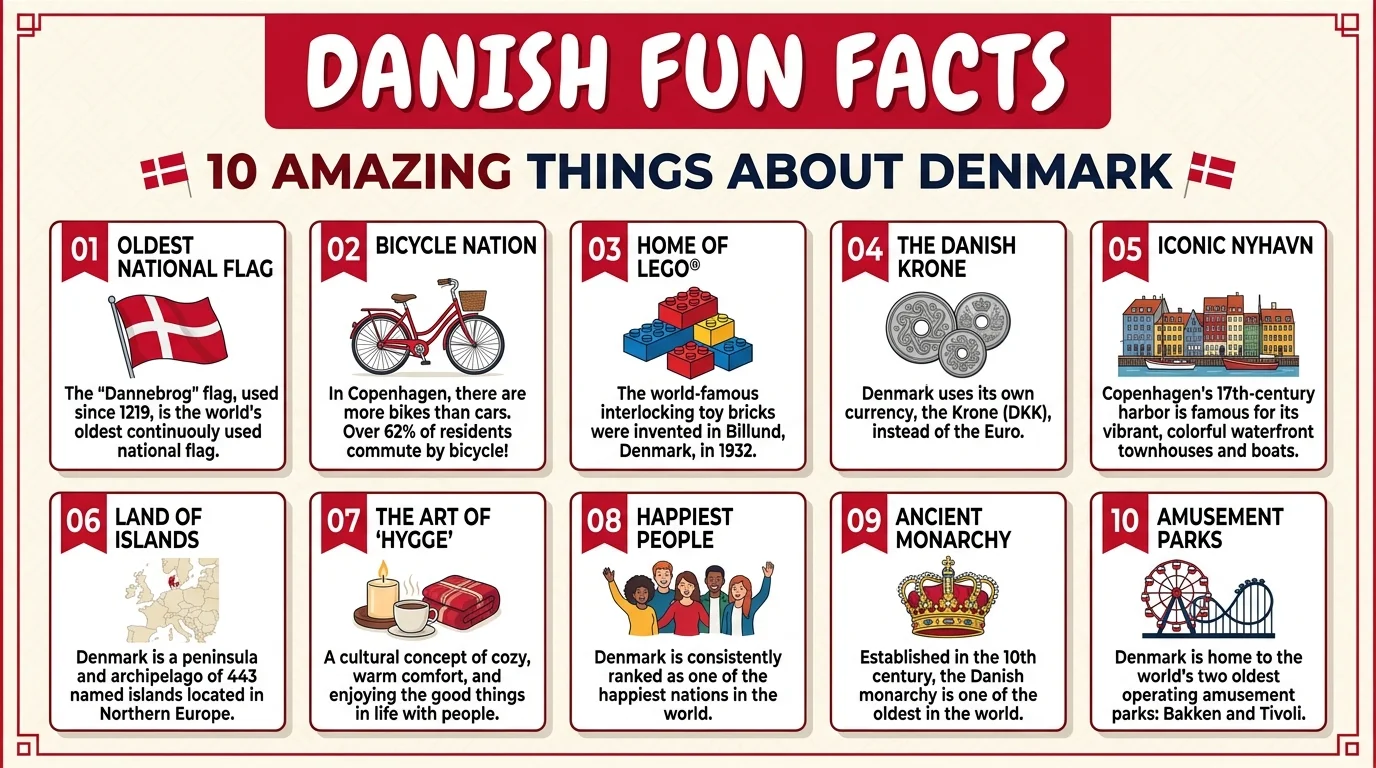
Denmark is packed with fascinating cultural quirks, historic marvels, and unique traditions. From hosting the world’s oldest amusement parks to consuming astonishing amounts of pastries and candy, these Danish fun facts reveal why this Scandinavian country consistently ranks among the happiest places on Earth.
Have you ever wondered what makes Denmark one of the happiest nations on Earth? Beyond picturesque, colorful harbors and sleek Scandinavian design, Denmark holds centuries of quirky history and unusual everyday habits.
When you start exploring Danish fun facts, you quickly discover that life here is full of delightful surprises. From biking through winter rainstorms to mastering the art of cozy living, the Danes certainly know how to live uniquely.
Whether you are planning a trip to Copenhagen or just love discovering fun world trivia, these Danish fun facts will give you a fresh look at Danish culture. Let us take a journey into the world of Denmark!
The Culture of Hygge and Danish Happiness
If you have spent any time looking into Northern European lifestyles, you have likely heard the word hygge. Pronounced “hoo-ga,” this concept is central to understanding Danish everyday culture.
It is not just a trend or a design aesthetic. It is an entire philosophy centered on comfort, togetherness, and taking life easy.
What Hygge Really Means to Everyday Danes
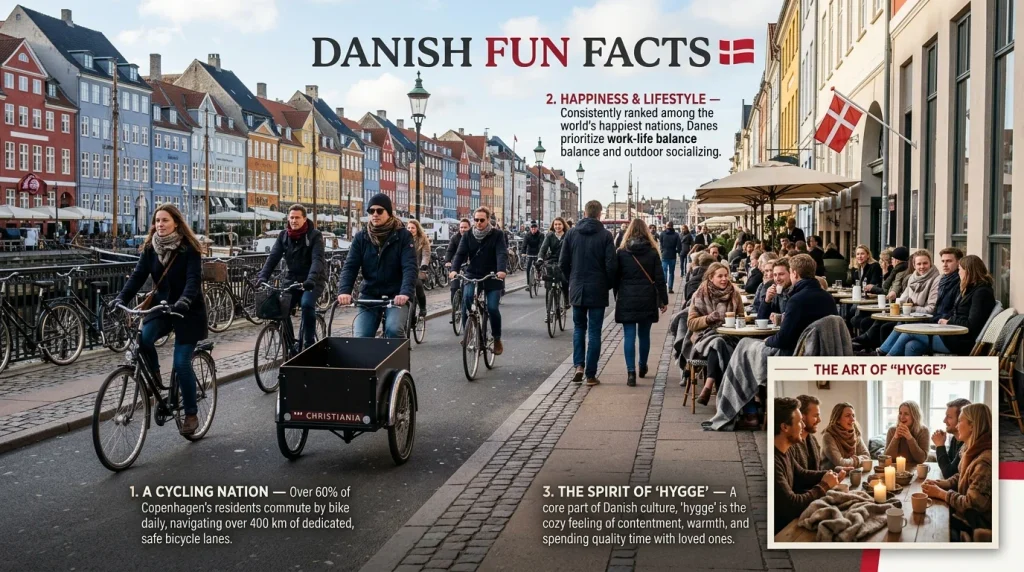
Hygge is best described as a feeling of cozy warmth and contentment. You experience it when sitting by a crackling fireplace with friends while sipping hot cocoa.
Danes create hygge using soft lighting, warm blankets, and good company. In fact, Denmark burns more candle wax per person than almost any other country in Europe!
Why Denmark Ranks High in Global Happiness Reports
Denmark consistently lands near the top of the United Nations World Happiness Report. While strong social systems play a big role, daily cultural attitudes are equally important.
Danes value work-life balance, trust their neighbors, and place high importance on personal well-being. They prefer relaxed family dinners over working late hours at the office.
Bicycles Rule the Roads in Denmark
Step outside any Danish train station and you will instantly notice thousands of bicycles stacked neatly in rows. In Denmark, cycling is not just exercise; it is the primary way to travel.
Children learn to ride bikes almost as soon as they learn to walk. Rain or shine, people ride bikes to work, school, and social events.
The Famous Cycling Stats of Copenhagen
In Copenhagen, over sixty percent of residents commute to work or school by bicycle every single day. The city features over nine hundred miles of dedicated, elevated bike lanes.
Even top government officials and politicians regularly cycle to parliament. It is often faster to ride a bike through the city center than to drive a car.
Biking Etiquette Every Visitor Must Know
Cycling in Denmark has strict social rules that everyone respects. You must use clear hand signals before stopping or turning into traffic.
- Extend your arm straight out to indicate a left or right turn.
- Raise your hand upward to show you are coming to a complete stop.
- Always look over your shoulder before passing another cyclist.
Fascinating Historic Traditions and National Symbols
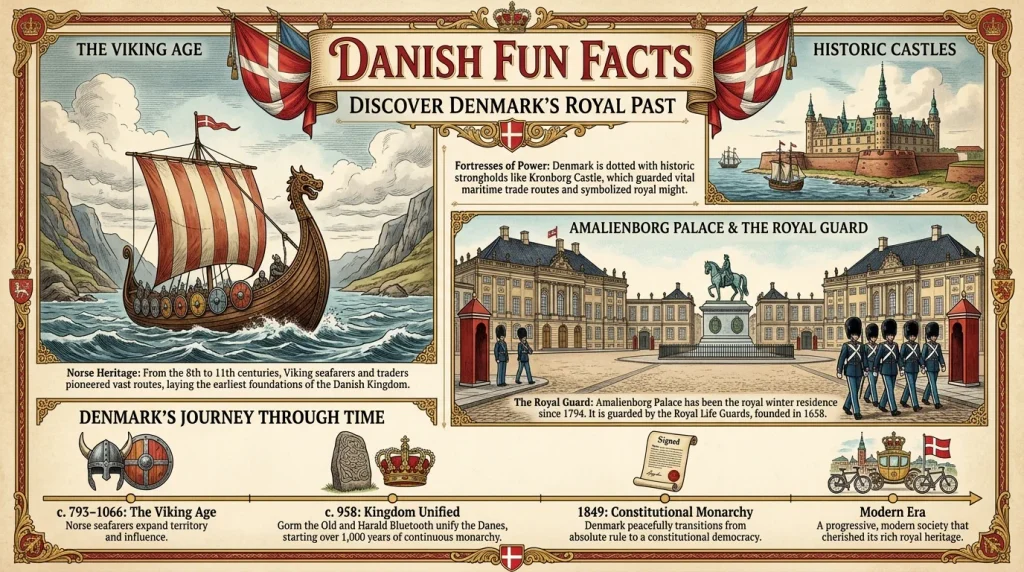
Denmark is home to one of the oldest continuous monarchies in the entire world. Its national symbols hold deep historical meaning that dates back to the Viking era.
The country manages to seamlessly blend centuries-old traditions with modern, forward-thinking social values.
The Legendary Origin of the Dannebrog Flag
The Danish flag, known as the Dannebrog, holds the Guinness World Record for being the oldest continuously used national flag in the world. Legend says it dropped from the sky during a battle in Estonia in the year 1219.
Danes love their flag immensely and use it for every celebration. You will see miniature Danish flags on birthday cakes, Christmas trees, and welcome signs at airports.
The Kingdom’s Royalty and Modern Society
The Danish Royal Family is deeply respected across the nation. Unlike many other royal families, Danish royals lead relatively accessible lives.
It is not uncommon to see royal family members shopping in local stores or biking through public parks. They bridge historical royal heritage with modern democratic values effortlessly.
Food, Pastries, and Culinary Quirks
Danish cuisine goes far beyond simple Nordic dishes. The country has a rich food culture that balances historical survival foods with modern culinary inventions.
From traditional rye bread open sandwiches to sugary breakfast treats, Denmark takes its food very seriously.
Smørrebrød and the Art of Open-Faced Sandwiches
Smørrebrød is Denmark’s signature lunch dish. It consists of a dense, dark rye bread base topped with various meat, fish, or cheese combinations.
There are traditional rules for how you eat smørrebrød. You must always use a knife and fork, and topping combinations follow strict historical recipes.
The Truth About the Danish Pastry
What the world calls a “Danish pastry” is actually called wienerbrød in Denmark, which translates to “Viennese bread.” Viennese bakers brought the dough recipe to Denmark in the 1850s during a bakers’ strike.
Danish bakers modified the recipe by adding generous amounts of butter and rich fillings. Today, Denmark produces some of the most famous baked goods on the planet.
Danish Inventions That Changed the Entire World
For a small country, Denmark has made a huge impact on global culture, design, and technology. Many items you use every day originated right here.
Danish innovation focuses heavily on functional design, child play, and clean environmental engineering.
How LEGO Was Created in a Small Woodshop
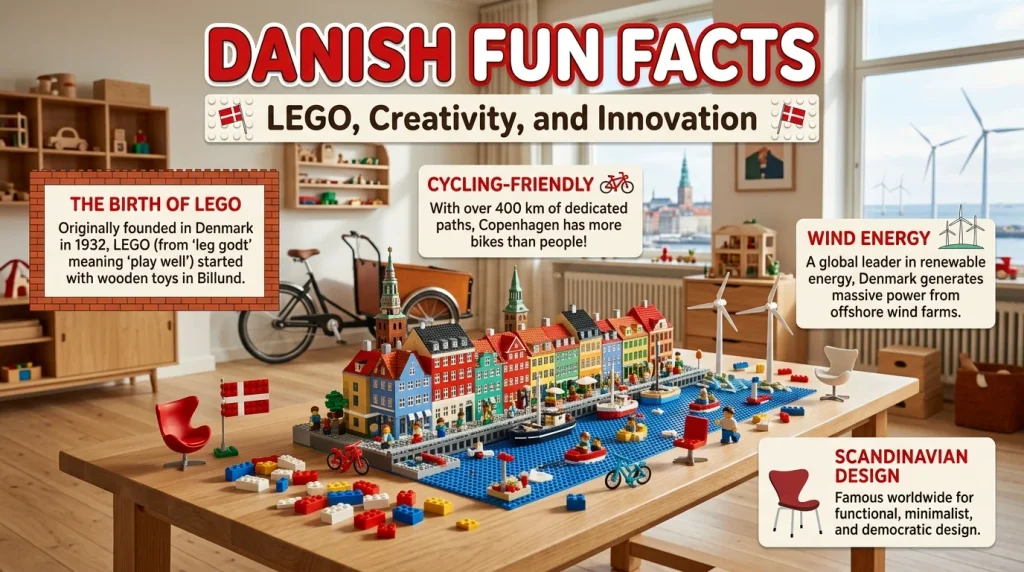
In 1932, a Danish carpenter named Ole Kirk Christiansen began making wooden toys in his workshop in Billund. He named his company LEGO, derived from the Danish phrase leg godt, which means “play well.”
Later, the company transitioned to plastic interlocking bricks. Today, LEGO is the largest and most successful toy company on the planet.
Other Surprising Everyday Danish Inventions
Beyond plastic building bricks, Danish inventors have shaped modern medicine and digital technology.
- The modern loudspeaker was invented by Peter L. Jensen in 1915.
- Pure insulin production techniques were developed in Denmark, leading to major diabetes care companies.
- Bluetooth wireless technology was named after a tenth-century Danish king, Harald Bluetooth!
Theme Parks and Fairy Tale Legends
Denmark inspired some of the world’s most famous stories and entertainment parks. Storytelling is deeply baked into the country’s national identity.
From ancient Viking folklore to beloved children’s books, Denmark feels like a living storybook.
The World’s Oldest Operating Amusement Parks
Denmark is home to the two oldest operating amusement parks in the world. Bakken opened in 1583 inside a beautiful wooden forest north of Copenhagen.
Tivoli Gardens opened in 1843 in the heart of Copenhagen. Tivoli served as a direct visual inspiration for Walt Disney when he planned Disneyland!
Hans Christian Andersen and His Magic Stories
The famous author Hans Christian Andersen was born in Odense, Denmark, in 1805. He wrote world-famous fairy tales like The Little Mermaid, The Ugly Duckling, and The Princess and the Pea.
Today, you can visit his original childhood home and see the famous Little Mermaid statue sitting on a rock along the Copenhagen harbor.
Quirky Social Rules and Daily Customs
Danish culture has several unique social norms that often surprise international visitors. Understanding these customs helps you appreciate how Danish society functions smoothly.
Modesty, equality, and mutual trust form the backbone of everyday life across Denmark.
The Law of Jante: Why Modesty Matters
Danish society operates on an unwritten cultural rule called Jante Law (Janteloven). Created by author Axel Sandemose in a 1933 novel, it teaches that no individual is better than anyone else.
Because of this concept, bragging about wealth, status, or success is strongly discouraged. Equality and team spirit are favored over personal vanity.
Trust in Society: Strollers Left Outside Cafes
One of the most surprising sights for tourists in Denmark is seeing baby strollers parked outside restaurants and shops. Parents leave sleeping babies in strollers outdoors while they enjoy lunch inside.
This happens because Denmark has exceptionally high levels of public safety and social trust. People trust that their neighbors will look out for one another.
Denmark’s Unique Geography and Coastal Life.
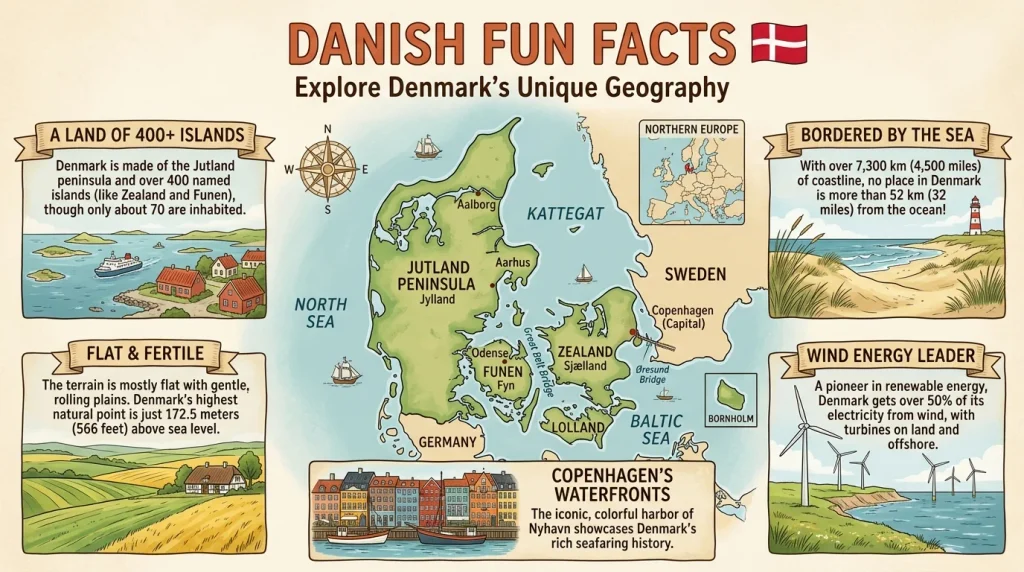
Denmark is made up of a mainland peninsula called Jutland and more than four hundred named islands. Only around seventy of these islands are inhabited.
Because of its unique scattered landmass, water is a huge part of every Dane’s daily existence.
You Are Never Far From the Ocean
No matter where you stand in Denmark, you are never more than thirty-two miles (fifty kilometers) away from the sea. The coastline stretches for over four thousand four hundred miles!
Danes love ocean swimming year-round. Even in the middle of winter, winter swimming clubs jump into freezing harbor waters before heading into hot saunas.
Denmark Has No Real Mountains
If you enjoy mountain hiking, Denmark might surprise you. The country is famous for being extremely flat, making it ideal for cycling and farming.
The highest natural point in Denmark is Møllehøj, standing at just five hundred sixty-one feet (one hundred seventy-one meters) above sea level!
Practice Exercises
1. What does the Danish word “Hygge” primarily represent in daily life? A. A strict athletic training routine
B. A lifestyle focused on coziest comfort and relaxed togetherness
C. A traditional political voting process
D. A high-speed cycling competition
2. Which nation’s flag holds the record for the oldest continuously used national flag? A. Norway
B. Sweden
C. Denmark
D. England
3. What percentage of Copenhagen residents commute to work or school by bicycle every day? A. Over 60%
B. Around 25%
C. Exactly 10%
D. Less than 5%
4. Where was the word “LEGO” derived from? A. A Latin word for building blocks
B. The Danish phrase “leg godt,” meaning play well
C. The founder’s family last name
D. An acronym for Danish toy manufacturing
5. What is Denmark’s signature open-faced sandwich called? A. Wienerbrød
B. Smørrebrød
C. Frikadeller
D. Koldskål
6. Bluetooth wireless technology was named after which historical figure? A. Hans Christian Andersen
B. Ole Kirk Christiansen
C. King Harald Bluetooth
D. Peter L. Jensen
7. How far are you from the ocean anywhere in Denmark? A. No more than 32 miles
B. At least 100 miles
C. Exactly 200 miles
D. Over 500 miles
8. What is the height of Denmark’s highest natural point, Møllehøj? A. 5,000 feet
B. 2,200 feet
C. 561 feet
D. 120 feet
9. Which famous amusement park in Copenhagen inspired Walt Disney? A. Bakken
B. Tivoli Gardens
C. Legoland Billund
D. Liseberg
10. What is “Janteloven” (The Law of Jante)? A. A written traffic law for bicycle users
B. An unwritten social code emphasizing humility and equality
C. A tax code for foreign visitors
D. A traditional recipe book rule
Answer Key
- B
- C
- A
- B
- B
- C
- A
- C
- B
- B
FAQs
What are some famous Danish fun facts for students?
Denmark is home to the world’s oldest amusement park, Bakken, which opened in 1583. Additionally, Denmark has more bicycles than people, and the famous LEGO building bricks were invented here in 1932 by a local carpenter.
Why do Danes burn so many candles every year?
Danes burn huge quantities of candles to create hygge, their signature cozy atmosphere during long winter months. Burning candles provides warm, natural light that encourages relaxation and friendly conversation indoors with family and friends.
Is Denmark really one of the happiest countries in the world?
Yes, Denmark consistently ranks in the top three happiest countries globally on official happiness index reports. Strong social trust, great work-life balance, free education, and healthcare all contribute heavily to high satisfaction levels among citizens.
What is the official language spoken in Denmark?
The official language of the country is Danish, a North Germanic language closely related to Swedish and Norwegian. However, over eighty-five percent of Danish citizens also speak fluent English as a second language.
Why are Danish pastries called Wienerbrød in Denmark?
Danish pastries are called wienerbrød because Austrian bakers from Vienna brought laminated dough recipes to Denmark during a 1850s baker strike. Danish bakers adapted the recipe with local butter and fillings, creating the treat we know today.
Can tourists rent bikes easily in Denmark?
Renting a bicycle in Denmark is extremely easy for tourists in almost every town and city. You can use public bike-share smartphone apps or rent directly from local hotels and shops to explore extensive bike path networks safely.
How cold does it get during Danish winters?
Danish winters are typically chilly, wet, and windy, with temperatures hovering right around freezing level. While extreme deep freezes are uncommon, dark winter days prompt locals to embrace warm clothing and cozy indoor gathering traditions.
Conclusion
Exploring these surprising Danish fun facts shows why Denmark remains such an intriguing and delightful place to discover. From world-changing inventions like LEGO to the daily practice of hygge, Danish culture balances ancient historic roots with modern social comfort.
Whether you plan to ride along Copenhagen’s cycling paths or enjoy a warm pastry at a local bakery, Denmark offers countless unique experiences. The country’s commitment to social equality, outdoor life, and simple pleasures serves as a great model for living well.
Next time you light a candle or assemble plastic building bricks, remember the rich Danish culture behind those simple everyday joys. What was your favorite Danish fact from our list? Reach out and let us know!

Ethan Danial is the creator and lead writer behind FunWhirls.com, a fun-focused platform dedicated to entertaining ideas, fascinating facts, funny moments, creative lists, and content that sparks curiosity. With a genuine love for discovering interesting and unexpected topics, Ethan enjoys turning simple ideas into engaging content that readers can enjoy, learn from, and share. His approach is centered on making every article easy to read, enjoyable, and worth coming back to.
At FunWhirls.com, Ethan Danial explores the lighter and more entertaining side of everyday life. He creates content for readers who love discovering something new, having a quick laugh, or simply taking a break from the ordinary. From curious facts to playful ideas and entertaining discoveries, Ethan aims to keep the content fresh, positive, useful, and engaging for readers of all kinds.